
Role of the Clerk of the Superior Court in San Diego County
California uses a unified trial court. There is one Superior Court of California, County of San Diego, and the clerk function sits inside that court. The Clerk of the Superior Court is not a stand-alone elected office. It is run by the Court Executive Officer, with Business Office staff at each branch courthouse. The clerk holds all case files for civil, criminal, family, probate, juvenile, mental health, and traffic matters. Staff stamp filings, log events on the Register of Actions, set hearing dates, issue process, take fees, and put out certified copies.
There is no Texas-style "District Clerk" in San Diego. There is also a separate elected office called the San Diego County Assessor/Recorder/County Clerk, often shortened to ARCC. ARCC is not a court clerk. It handles deeds, vital records, fictitious business names, and notary oaths. The two offices are easy to mix up by name, but the work is split. See the short note further down on this page, plus the marriage and divorce records page and the public records page for the ARCC side.
Central Courthouse Business Office
Office: Clerk of the Superior Court
1100 Union Street
San Diego, CA 92101
(619) 844-2700
Criminal / Older Records: (619) 844-2400
Family Business Office: (619) 844-2777
Probate: (619) 844-2676
Appeals: (619) 844-2348
Most counters: 8:30 a.m. to 4:00 p.m.
Phones: 8:30 a.m. to 11:30 a.m., Mon-Fri
Court Executive Officer and Clerk Function
The Court Executive Officer runs day-to-day court operations and supervises the clerk staff at every branch. That includes the Business Offices, the older records room, the appeals counter, and the back-office teams that process e-filings. The role covers budget, staffing, court reporters, jury services, and the case management system that powers the Register of Actions. The Presiding Judge sets judicial policy. The Court Executive Officer runs the clerk side of the court.
Each branch courthouse has its own Business Office. Filings go in there. Copies come out of there. Hearings show up on the calendars built by the same office. The court spreads the clerk function across seven sites in the county so that people in Vista, El Cajon, Chula Vista, Kearny Mesa, and downtown San Diego can all reach a counter without driving across the region.
Business Offices at Each San Diego Courthouse
The clerk runs Business Offices at all seven Superior Court sites. Each office takes filings for the case types heard at that branch. The court keeps the full list on its court locations page. The table below sets out the address and main phone line for each one.
| Branch | Address | Phone |
|---|---|---|
| Central Courthouse | 1100 Union Street, San Diego, CA 92101 | (619) 844-2700 |
| Hall of Justice (Civil) | 330 West Broadway, San Diego, CA 92101 | (619) 450-7275 |
| North County Regional Center | 325 South Melrose Drive, Vista, CA 92081 | (760) 201-8600 |
| East County Regional Center | 250 East Main Street, El Cajon, CA 92020 | (619) 456-4100 |
| South County Regional Center | 500 Third Avenue, Chula Vista, CA 91910 | (619) 746-6200 |
| Juvenile Court | 2851 Meadow Lark Drive, San Diego, CA 92123 | (858) 634-1600 |
| Kearny Mesa Traffic | 8950 Clairemont Mesa Boulevard, San Diego, CA 92123 | (858) 634-1800 |
Civil and Small Claims filings move through the Hall of Justice. Criminal, probate, family, appeals, older records, and administration sit at Central. North, East, and South run full-service branches. Juvenile is on Meadow Lark Drive. Traffic and minor offense work centers at Kearny Mesa, with traffic counters also active at the regional centers.
Filing Cases and Documents with the Clerk
The clerk takes filings two ways: in person at a Business Office or online through an e-filing service. The court accepts e-filings through OneLegal and File & ServeXpress for case types that the court has approved for electronic submission. For civil filings the court directs users to the Civil Division page for the local rules, mandatory cover sheets, and the list of forms that must travel with the lead pleading. Filing fees are set under state law and a fee waiver, FW-001, is available for people who qualify.
Paper filings go to the same Business Office that handles the case type. Family files go to the Family Business Office on the 4th floor of the Central Courthouse. Probate files go to the Probate counter, also at Central. Small claims filings go through the Hall of Justice. Mail filings need a self-addressed stamped envelope and the right fee. The clerk will not accept a filing without the lead form, the right caption, and the correct fee or a granted waiver.
- Pick the branch that handles the case type.
- Bring the lead pleading plus all required attachments.
- Bring two extra copies for conformed-copy stamps.
- Pay the filing fee or bring a granted fee waiver.
- For e-filing, use OneLegal or File & ServeXpress.
Requesting Court Records from the Clerk
The clerk holds the case file from the day a case is opened. The Court Index finds the case number and branch. The Register of Actions then shows the events, hearings, and filings. To pull a hard copy file, walk in at the branch that holds the case, give the case number, and show a photo ID. Staff pull up to ten cases per customer per visit. Non-party searches that run over ten minutes may add a search fee under Government Code section 70627(c).
Mail requests need the case number, the party names, the document name, contact details, a self-addressed stamped envelope, and payment. Mail copy work can take several weeks. Online buyers can purchase imaged documents through the civil, small claims, probate, and family Register of Actions sites, where available. Most case details, hearings, parties, and tentative rulings are free to view online.
How to Request a Certified Copy from San Diego Superior Court
A certified copy is a court file copy stamped and signed by the clerk to prove it matches the official record. Banks, schools, and immigration officers ask for them. The court issues certified copies of judgments, divorce decrees, name change orders, abstracts, and many other final orders.
- Find the case number through the Court Index or by calling the branch that handled the case.
- Pick up or print the records request form for the right division, civil, family, criminal, or probate.
- List the case number, party names, document name, number of copies, and whether you need certification.
- Mail or hand in the form with payment and, for mail orders, a self-addressed stamped envelope.
- Pick up at the counter or wait for the certified copies to arrive by mail.
For criminal copies, the request goes to the branch where the case was heard. Criminal documents are not for sale online. Civil, small claims, probate, and family copies may also be ordered through the online Register of Actions for eligible cases.
Records Request Form Fields
The standard request form, whether walked in, mailed, or sent through online ROA, asks for the fields below. Fill in as many as you can. The clerk uses these to pull the case, find the right document, and quote the fee.
| Field | Required | Notes |
|---|---|---|
| Case Number | Yes if known | Use the Court Index to find it. Format XX-YYYY-########-CC-TT-LLL or shortcut YYYY########. |
| Case Location | Yes | Central, Hall of Justice, North, East, South, Kearny Mesa, Juvenile, or Ramona. |
| Party Names | Yes | Plaintiff or petitioner and defendant or respondent. |
| Document Type | Yes | Judgment, decree, minute order, complaint, abstract, or other. |
| Date Filed or Date Range | Helpful | Narrows the search when the case number is not known. |
| Number of Copies | Yes | Plain or certified count. |
| Certification Needed | Yes/No | Adds the certification fee per document. |
| Requester Contact | Yes | Name, address, phone, and email if available. |
| Self-Addressed Stamped Envelope | Yes for mail | Required for mail returns. |
| Payment | Yes | Check, money order, or card per branch policy. |
San Diego Clerk Fees for Records and Copies
Fee amounts come from court orders, state statutes, and the Government Code. The table below sets out the most common clerk fees for records and copy work.
| Item | Amount |
|---|---|
| Plain copy from file or microfilm/microfiche | $0.50 per page |
| Online document, first 5 pages | $1.00 per page |
| Online document, each page after 5 | $0.40 per page |
| Online document cap | $50 per document |
| Certification fee per document | Per court schedule |
| Records search over 10 minutes | Gov. Code 70627(c) search fee |
| Online payment | Visa or Mastercard |
| Mail copy hold time | Several weeks |
Online purchases stay on the buyer's account for 90 days from the date of purchase. Civil, small claims, probate, and family cases opened on or after January 1, 2008, or imaged from August 24, 2015 for family, may have purchasable PDFs. Criminal documents are never sold online. Fee waivers do not cover copy fees.
Records Retention Schedule
The clerk does not keep every paper forever. Government Code section 68152 sets retention timeframes for trial court records. Section 68153 sets the destruction procedure once a retention period ends. Common limits at San Diego include traffic infractions purged after 3 years, misdemeanor traffic after 5 years, and DUI misdemeanors after 10 years. Civil Limited and misdemeanor cases may be available for only 10 years at some branches.
If the file is past its retention date, the clerk cannot pull it. The Court Index will still show a stub if the case is in the 1974-forward range. Court reporter notes and electronic recordings also follow set retention windows. Confirm with the branch before driving over.
Older Records and Archives
Cases before 1974 are not on the Court Index. The Older Records area at the Central Courthouse holds pre-1974 indexes. Indexes from 1880 to 1964 are in large hardbound books. Post-1964 entries are in computer-generated indexes. The Older Records team works on the 14th floor at Central. Phone (619) 844-2400 reaches Criminal and Older Records.
Old cases sometimes need staff search time. Bring as much detail as you can: party names, year, case type, and a likely branch. Some very old files have been transferred or destroyed under the retention rules. The clerk can confirm what is left in the file room.
ARCC Is a Separate Office, Not the Court Clerk
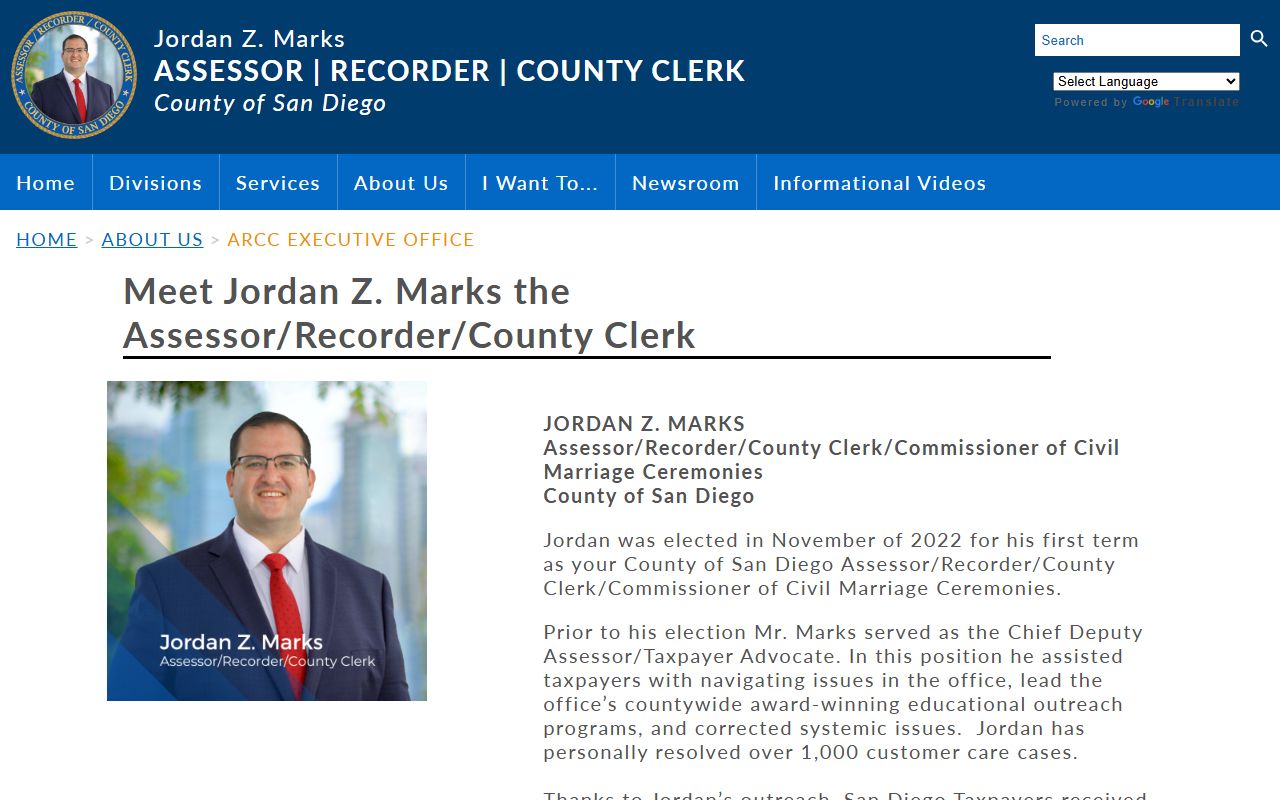
The San Diego County Assessor/Recorder/County Clerk, or ARCC, is a separate elected office. It is not part of the Superior Court. The elected official is Jordan Z. Marks, who took office in 2022 for a term that runs through 2026. ARCC handles recorded documents like deeds, liens, and reconveyances, plus vital records, fictitious business names, and notary oaths. It does not hold court case files, divorces, wills, or adoptions. Those stay with the Superior Court clerk.
For an overview of ARCC office hours and the four service locations, the agency keeps a public locations page. Source: sdarcc.gov ARCC locations.
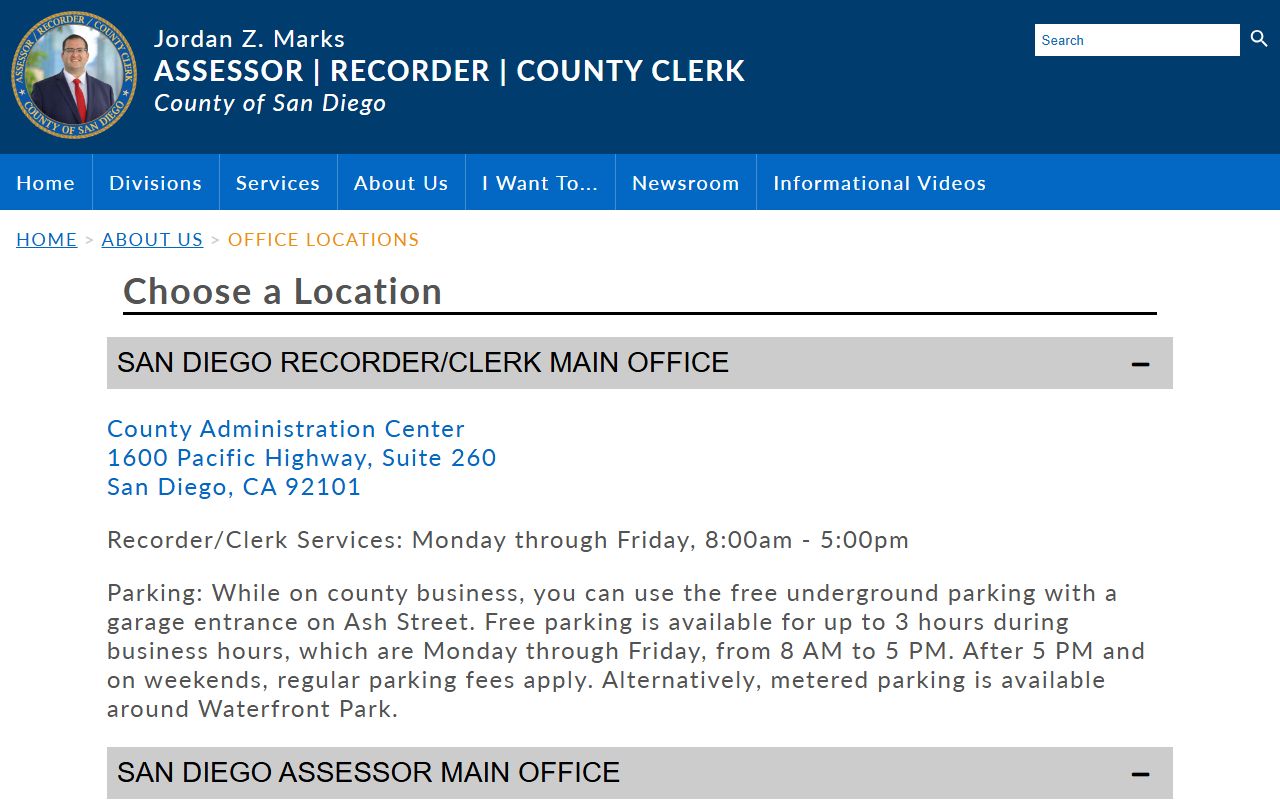
The main ARCC office sits at 1600 Pacific Highway, Suite 260, in the County Administration Center. Branches are in Santee, Chula Vista, and San Marcos. ARCC also runs a Kearny Mesa office for assessor services only. None of those locations handle court filings.
Jordan Z. Marks serves as Assessor, Recorder, County Clerk, and Commissioner of Civil Marriage Ceremonies for the county. The agency keeps a short bio on its executive page. Source: sdarcc.gov executive office bio.
For ARCC fees on recorded documents, marriage licenses, and certified vital records, the agency publishes a current fee schedule that takes effect January 1, 2026. Source: ARCC 2026 fee schedule PDF.
For marriage licenses and certified marriage, birth, or death records, see marriage and divorce records. For deeds and other recorded documents, see public records. For court filings, stay with the Superior Court clerk.