
How to Search San Diego County Court Records
The Superior Court of California, County of San Diego, runs a two-layer public search. The first layer is the Court Index at courtindex.sdcourt.ca.gov. It locates a case number and the court branch holding the file. The second layer is the Register of Actions, or ROA. The civil, small claims, probate, and criminal ROA sits at odyroa.sdcourt.ca.gov. The family ROA lives at roasearch.sdcourt.ca.gov. Both are free to view. Documents may be bought online for select case types.
Before you start, gather what you know. A full name is the best lead. A case number is even better. The case type and a rough filing year both narrow the results. The court warns that the index limits the number of returned rows, so more detail makes the search faster and more useful.
- Open the Court Index landing page and pick Party Name Search, Case Number Search, or DA Number Search.
- Choose a case type. Options are Civil, Criminal, Domestic, Mental Health, or Probate.
- Choose a case location. Options include East County, Kearny Mesa, North County, Ramona, San Diego, South County, or Unknown-All.
- Enter the last name and first name, or paste a case number with no dashes. The shortcut format is the four-digit year plus the eight-digit case number.
- Review the hit list. Note the case number, case location, and case title.
- Take the case number to the right ROA portal, run a Case Search, and open the case details.
- Read the parties, scheduled hearings, and the filing summary. Buy copies of imaged documents if you need them, or visit the courthouse for hard copy review.
San Diego County Court Records Search Fields
The Court Index Party Name Search is the most-used screen. The fields below show what to enter and how the court reads each one. Party type only matters for civil and family cases. Year fields take a four-digit year. The last name is the field that drives the search.
| Field Label | Type | Required | Notes / Format |
|---|---|---|---|
| Case Type | Dropdown | Yes | Civil, Criminal, Domestic, Mental Health, or Probate. |
| Case Location | Dropdown | Yes | East County, Kearny Mesa, North County, Ramona, San Diego, South County, or Unknown-All. |
| Party Type | Dropdown | Optional | Defendant/Respondent or Plaintiff/Petitioner. Used only when case type is Civil or Domestic. |
| Beginning Date Filed Year | Text/Year | Optional | Four-digit year. Sets the start of the search window. |
| Ending Date Filed Year | Text/Year | Optional | Four-digit year. Sets the end of the search window. |
| Last Name or Business Name | Text | Yes | More letters cut down the result count and run faster. |
| First Name | Text | Optional | Adding a first name speeds the match. |
| Date of Birth | Date | Optional | Helps match the right person in criminal hits. |
The Case Number Search is the fastest path when you already have the number. Drop the dashes. If the number looks like XX-YYYY-########-CC-TT-LLL, the shortcut is the four-digit year plus the eight digit case sequence. The DA Number Search is for criminal files where you only know the District Attorney number.
Types of San Diego County Court Records
The Superior Court handles every trial-level case type for the county. There is one trial court here, not several. Civil and small claims, criminal, family, probate, mental health, and juvenile all sit under the same court. The case flow is Superior Court › Court of Appeal (Fourth District, Division One) › Supreme Court of California.
Each case type leaves a different paper trail. Some types post documents to the ROA. Others are kept in hard copy at the branch where the case was heard. The list below shows what each record group covers.
- Civil records: complaints, answers, motions, proofs of service, orders, judgments, name and gender change petitions, civil harassment restraining orders, unlawful detainers, small claims, and appeals. Some civil and small claims documents filed on or after January 1, 2008 may be bought online.
- Criminal records: felony, misdemeanor, and infraction cases from 1974 forward. Court Index returns them, but criminal documents are not viewable or downloadable online. View in person or order copies by mail.
- Family records: divorce, legal separation, custody, child and spousal support, and domestic violence restraining orders. Imaged family cases filed on or after August 24, 2015 may have documents for sale through the family ROA.
- Probate records: wills, estates, trusts, guardianships, and conservatorships. The Probate Business Office is in the Central Courthouse. Some probate documents are on the ROA, but guardianship and conservatorship documents are not.
- Traffic and minor offense records: infractions, misdemeanor traffic, and DUI. Not in the Court Index. Visit or call the branch that heard the case. See San Diego County traffic court records for the citation lookup path.
- Mental health records: the Court Index lists mental health cases, but most documents are restricted by statute or rule.
- Appeals: notices of appeal, designations, clerk's transcripts, and appellate calendars. Limited civil, misdemeanor, infraction, and small claims appeals run through the Superior Court's Appellate Division. Unlimited civil, felony, family, and probate appeals go to the Court of Appeal.
Civil Limited and Misdemeanor records may only be available for 10 years at some court locations. Older indexes from 1880 to 1964 sit in bound books at the Central Division Older Records area. Post-1964 indexes are computer generated.
What a San Diego County Court Record Shows
A court record holds the facts of the case and the steps the case has taken. The Court Index shows summary fields. The ROA adds the timeline and the document list. The card below lists the fields you will see in most San Diego court files.
Read each line as a snapshot of the case. The case number is the unique ID. The case location tells you which branch holds the file. The parties show who is suing whom or who the state has charged. Hearings tell you what is next on the court calendar. Filings tell you what has been put in the file so far.
I have given you the official link to the court's instructions for ordering copies. The page covers online, in person, and mail paths, plus what each path costs and how long each one takes. Source: sdcourt.ca.gov copy instructions.
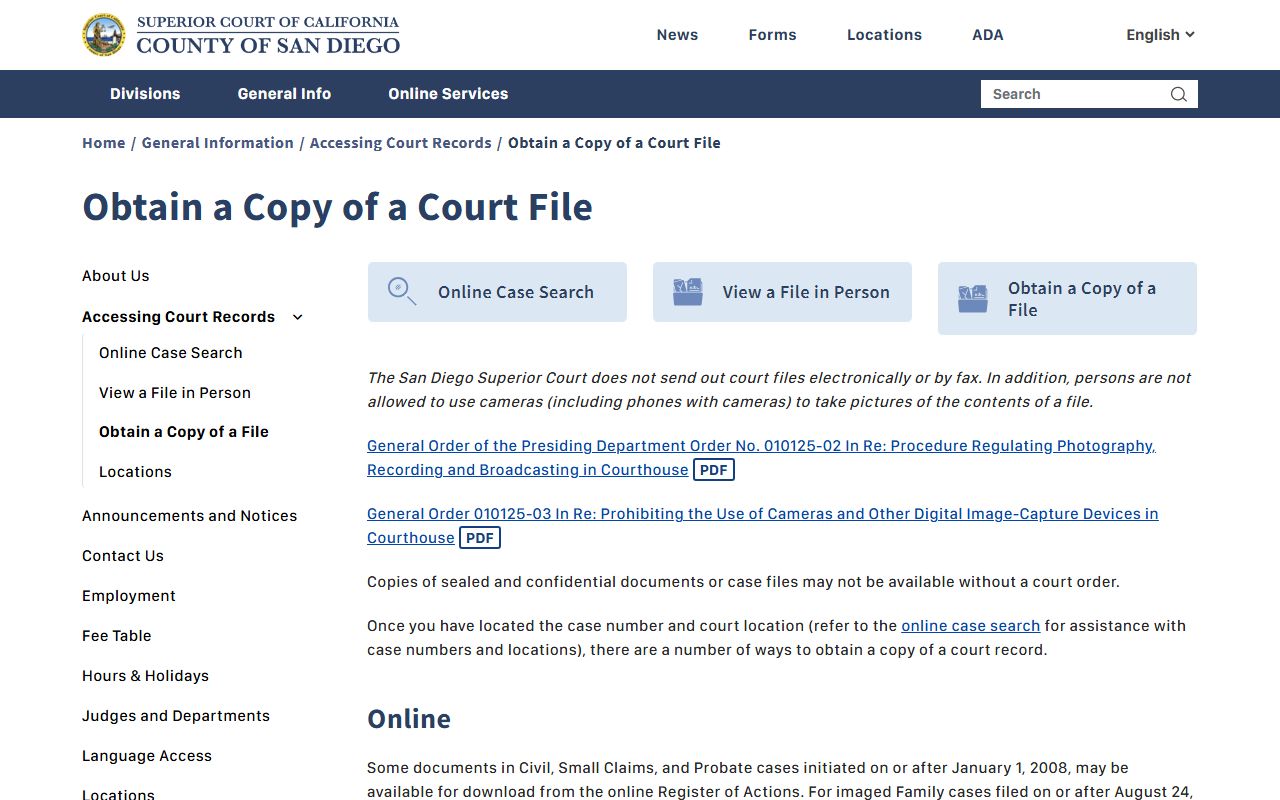
The court's copy page lays out the three lanes and the fees that apply to each. Most online buyers pay $1 per page for the first five pages, then $0.40 each, with a $50 cap per document.
| Field | What It Shows |
|---|---|
| Case Number | The unique case ID. Format is XX-YYYY-########-CC-TT-LLL, with a shortcut of YYYY########. |
| Case Title | The case caption or short party names, such as Smith v. Jones. |
| Case Type / Category | Civil, Criminal, Domestic, Mental Health, or Probate. ROA also uses Civil (Small Claims). |
| Case Location | Central, Hall of Justice, North County, East County, South County, Kearny Mesa, Ramona, or Appellate Division. |
| Date Filed | The day the case was opened. Used to limit searches by year. |
| Parties | Plaintiff or petitioner, defendant or respondent, business entity, and party role. |
| Hearings | Hearing date, time, department, and hearing type. |
| Filings / Events | Complaint, petition, motion, proof of service, minute order, tentative ruling, order, judgment, notice of appeal. |
| Documents | Some civil, small claims, probate, and family documents are for sale online. Criminal documents are not online. |
| Disposition | Final or current outcome of a charge or case. |
| Fees / Financial | Copy charges, search fees, fines, bail or bond items, and judgment interest details. |
| Restrictions | Sealed or confidential markers, juvenile flags, and remote-access limits under CRC 2.503. |
Public Access Framework for San Diego County Court Records
California court files are public records, but they sit under a set of court rules, not under the standard agency request path. San Diego Superior Court cites California Rules of Court rule 2.400 for the right to inspect court papers in the clerk's office. It cites rule 2.550 for the presumption that court records are open unless sealed. Electronic access is narrower than courthouse access. Rule 2.503 requires online access to indexes, calendars, and registers of actions where feasible, but limits remote access for criminal, family, juvenile, and mental health files.
At the county-agency level, the California Public Records Act, Government Code section 7920.000 covers requests to the Sheriff and the Assessor/Recorder/County Clerk. Court-record retention is set by Government Code section 68152. Any person may inspect or copy a public court record. ID is needed to pull a hard file. Fees apply for copies and for non-party searches over 10 minutes. See public records for the broader request workflow.
Note: Courthouse files are pulled in batches of ten cases per customer per visit, and the records office may charge a search fee when staff time runs past ten minutes.
Records That Are Sealed or Confidential in San Diego County
Several record types are off limits to the general public. Juvenile records are confidential under Welfare and Institutions Code section 827. The minor, parents or legal guardians, and attorneys of record can ask for selected minutes and documents in person with photo ID. Other people must file Judicial Council form JV-570. Adoption records are also confidential and routed through Juvenile Court. Guardianship, conservatorship, civil harassment, workplace violence, and elder abuse documents are not on the public ROA under court rules.
For arrests that did not result in a conviction, Penal Code section 851.91 lets a qualifying person petition to seal the arrest record. If granted, the arrest is treated as if it did not occur for most uses, with carve-outs for peace officer hiring, licensing, and public office. San Diego's Criminal Division runs a "Clearing Your Record" path. The petition is filed in the court that handled the case or arrest.
Sealed records can only be opened by court order. The image below is the official viewing-instructions page for hard-copy files. Source: sdcourt.ca.gov view-a-court-file page.
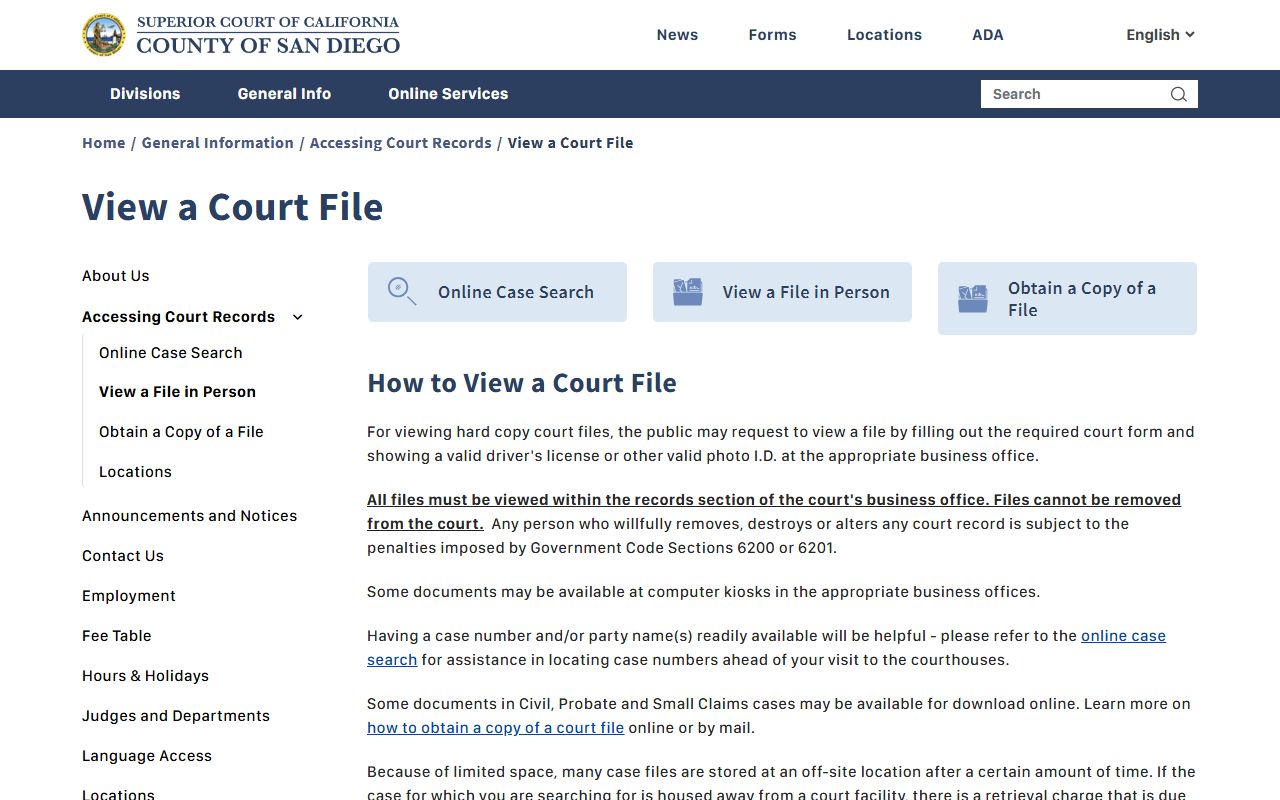
The page sets the in-person rules. You bring a photo ID, you give the case number, and staff pull the file at the records section. Files cannot be removed. Copies from microfiche or microfilm are 50 cents per page.
In-Person Court Record Requests
Hard-copy files are kept at the branch that heard the case. The main records office is at the Central Courthouse. For civil and small claims, the Hall of Justice has its own business office. Bring a photo ID and the case number. Staff pull a maximum of ten cases per request, per customer, per visit. Mail requests need the case number, party names, document names, contact info, a self-addressed stamped envelope, and payment.
Central Courthouse, Records Section
1100 Union Street
San Diego, CA 92101
(619) 844-2700
Monday-Friday, 8:00 a.m. to 4:30 p.m.