
How to Search San Diego County Court Records
The main tool is the Court Index. It finds the case number and the court location for civil, criminal, family, mental health, and probate cases filed in San Diego Superior Court. The Court Index does not cover juvenile cases, traffic or minor offense cases, or cases filed before 1974. Once you have a case number, you can use the Register of Actions for civil, small claims, probate, and criminal cases, or the family ROA at roasearch.sdcourt.ca.gov. Both ROA systems show case details, parties, hearings, and a filing summary. Some documents can be bought online for a fee.
Have a few things ready before you start. A full name, a year range, and a case type help cut the result list. The court warns that the Court Index limits how many results it returns, so more detail is better. If you only have a Distrct Attorney number, use the DA Number search tab. The site also lets you search by case number when the format is known.
The San Diego Superior Court explains its access process on the access-to-court-records page, which lists what is online and what must be viewed in person.
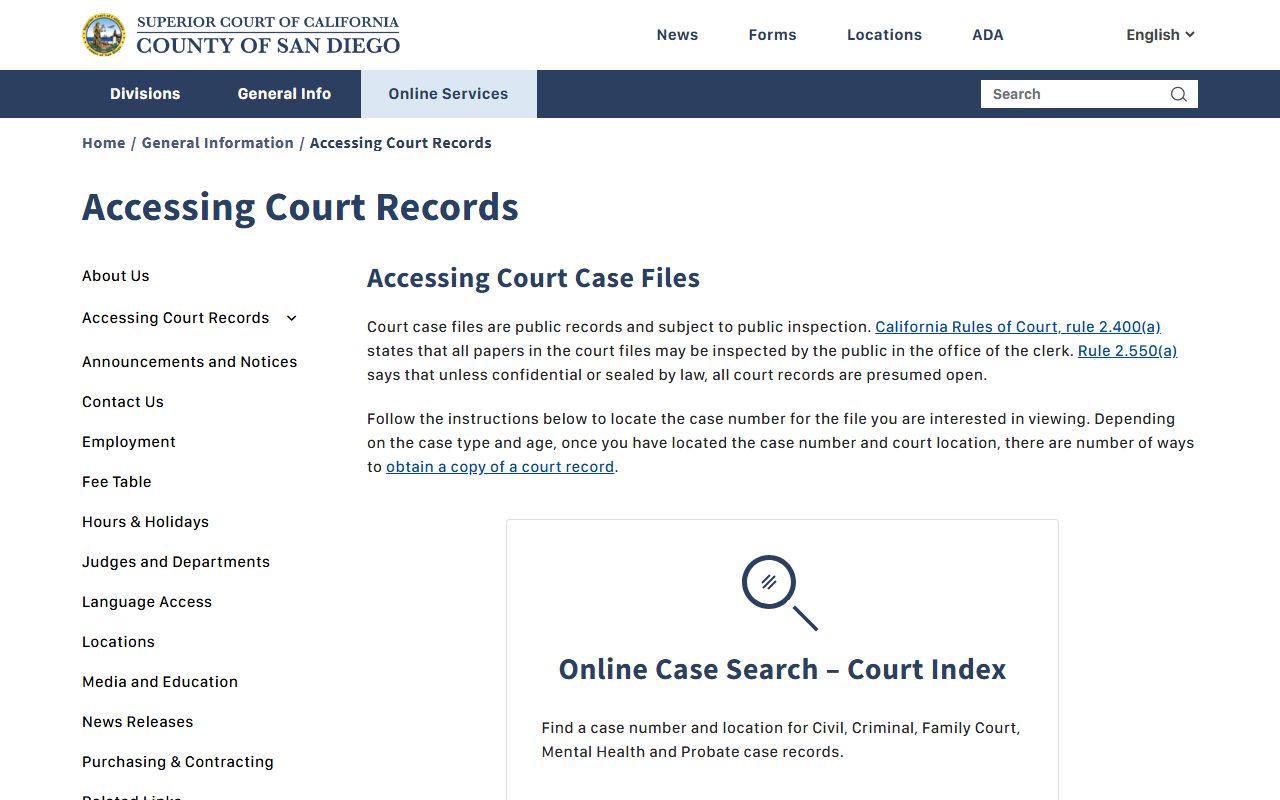
The screenshot shows the court's official entry point for case access, with links to the Court Index, the Register of Actions, and in-person file viewing rules.
- Open the Court Index at courtindex.sdcourt.ca.gov/CISPublic/enter.
- Pick the search tab: Party Name, Case Number, or DA Number.
- Enter case type (civil, criminal, domestic, mental health, probate) and case location.
- Type the last name and first name, with a date range if you have one.
- Note the case number, file date, and case location from the result list.
- Open the Register of Actions and search by that case number to see filings and hearings.
- Buy a copy online when allowed, or mail a copy request to the court site that has the file.
The Court Index landing page below shows the case types and locations the system covers. Civil Limited and Misdemeanor records may be kept only ten years at some branches.
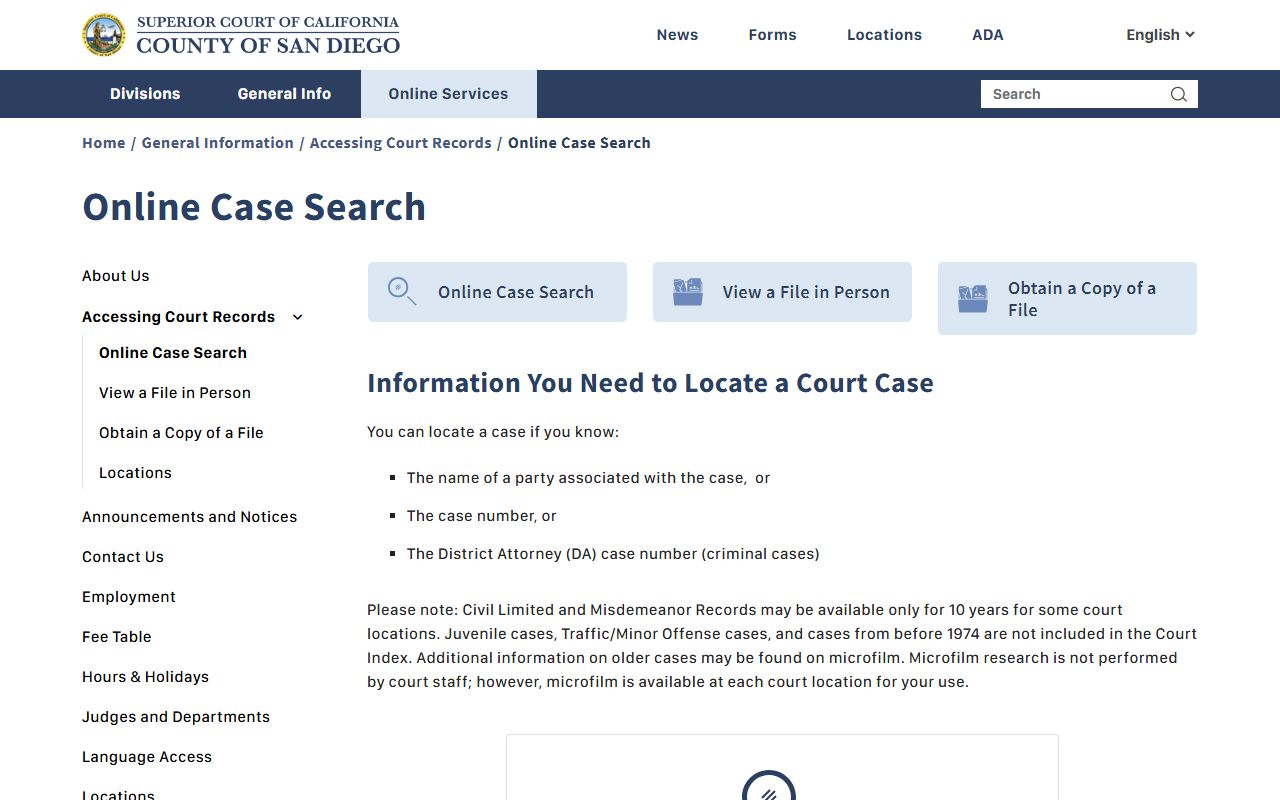
Court Index Party Name Search Fields
The Party Name search is the most used path. The table below shows every field on the form. The court says more characters in the last and first name fields make results faster and more focused. Party type is used only with civil or domestic cases.
| Field | Required | Notes |
|---|---|---|
| Case Type | Yes | Civil, Criminal, Domestic, Mental Health, or Probate |
| Case Location | Yes | East County, Kearny Mesa, North County, Ramona, San Diego, South County, or Unknown-All |
| Party Type | Civil or Domestic only | Defendant/Respondent or Plaintiff/Petitioner |
| Beginning Date Filed Year | Optional | Year only |
| Ending Date Filed Year | Optional | Year only |
| Last Name or Business Name | Yes | More characters speed the search |
| First Name | Optional | Use full first name when possible |
| Date of Birth | Optional | Helps match on criminal records |
Results return the case title, case number, case location, case type, file date, and the parties. Criminal docs are not online to view or download. You can view them in person at the court site where the case was heard, or pay for a mailed copy. For civil, small claims, and probate cases filed on or after January 1, 2008, some docs can be bought online through the ROA.
The San Diego County Judicial System
California has a three-tier court system. The Supreme Court of California sits at the top. Below it are six Courts of Appeal. San Diego County is in the Fourth District Court of Appeal, Division One, which sits in San Diego. The trial court for the county is the Superior Court of California, County of San Diego. It is one of 58 county trial courts in the state. San Diego does not have Texas-style district courts, county courts at law, justice of the peace courts, or stand-alone probate courts. All trial work runs through the Superior Court and its divisions.
The Superior Court hears felonies, misdemeanors, infractions, civil disputes, family law, support, probate, conservatorship, mental health, juvenile, and small claims cases. Small claims handles money disputes of $12,500 or less. The Appellate Division of the Superior Court hears appeals from limited civil, misdemeanor, infraction, traffic, and small-claims matters. Unlimited civil, felony, family, and probate appeals go to the Court of Appeal.
Case flow: Superior Court › Court of Appeal (Fourth District, Division One) › Supreme Court of California
| Court | Role | Case Types |
|---|---|---|
| Superior Court (Trial) | First-level court for all cases filed in the county | Criminal, civil, family, probate, juvenile, traffic, small claims, mental health |
| Appellate Division of the Superior Court | Reviews limited matters | Limited civil, misdemeanor, infraction, traffic, small claims |
| Court of Appeal (Fourth District, Division One) | State intermediate appeals court | Unlimited civil, felony, family, probate appeals from San Diego |
| Supreme Court of California | State court of last resort | Discretionary review on rules of statewide importance |
Note: The Superior Court is unified, so divisions handle work that other states split among several courts.
San Diego County Courthouses
San Diego Superior Court has one downtown hub and four branch courthouses, plus a juvenile site and a traffic court. The Central Courthouse opened in late 2017. It holds criminal, probate, family, appeals, administration, and older records. Hall of Justice handles civil and small claims business. The court lists every site on its court locations page.
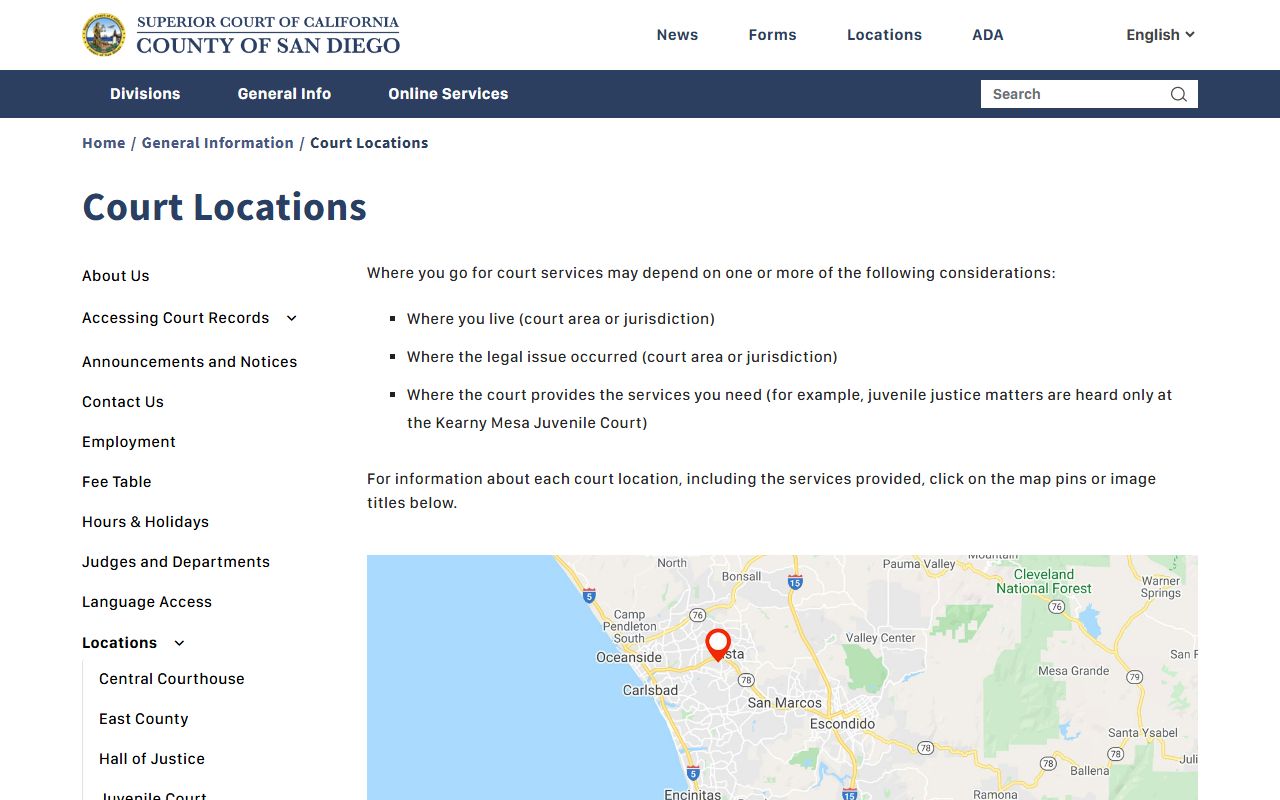
The location overview lists every branch from Central to Kearny Mesa Traffic Court, with phones and case coverage for each. The address cards below cover the five busiest sites.
Kearny Mesa Traffic Court
8950 Clairemont Mesa Boulevard
San Diego, CA 92123
(858) 634-1800
Juvenile Court sits at 2851 Meadow Lark Drive, San Diego, CA 92123, with general office (858) 634-1600. Juvenile cases are confidential, so the public cannot search the docket.
Types of San Diego County Court Records
San Diego County court records cover almost every kind of case a state trial court can hear. Each case type has its own filing rules and its own access rules. Civil and probate records are mostly open. Criminal records are open in person but not online. Juvenile and mental health files are mostly closed. Traffic records are kept at the branch where the cite was tried, not on the Court Index.
- Civil records: complaints, motions, judgments, name and gender change petitions, unlawful detainers, and small claims.
- Criminal records: felony, misdemeanor, infraction, sentencing, probation, and bail records from 1974 forward.
- Family records: dissolution, custody, support, and domestic violence restraining orders. Family ROA covers cases filed on or after August 24, 2015.
- Probate records: wills, estates, trusts, guardianships, and conservatorships. Most are open but guardianship and conservatorship docs are not on ROA.
- Traffic records: infractions, misdemeanor traffic, DUI, and juvenile infractions. Files must be requested at the site where tried.
- Court dockets: the chronological event list for a case, also called the Register of Actions in California.
Mental health case records can be found through the Court Index, but many docs in those files are restricted by statute. Appeals records, including notices of appeal and clerk's transcripts, are kept at the court site that heard the case and at the Court of Appeal.
What San Diego County Court Records Show
A typical case record has a set of common fields. The Court Index recognizes the case number format XX-YYYY-########-CC-TT-LLL. The short entry form is YYYY########, with no dashes. The ROA adds the events list and any imaged docs that can be bought.
| Field | What It Shows |
|---|---|
| Case Number | The unique court file ID, formatted XX-YYYY-########-CC-TT-LLL. |
| Case Title | Caption or short party names, such as Smith v. Jones. |
| Filing Date | The date the first paper was filed with the clerk. |
| Parties | Plaintiff, defendant, petitioner, respondent, or business entity, with party role. |
| Case Location | Central, Hall of Justice, North, East, South, Kearny Mesa, or Appellate Division. |
| Hearings | Date, time, and department for each court appearance. |
| Filings / Events | Complaint, motion, order, minute order, tentative ruling, judgment, notice of appeal. |
| Disposition | Current or final outcome of the charge or case. |
| Sentence / Judgment | The court's final decision, dollar award, custody term, or other order. |
Some fields are hidden when a record is sealed or confidential. Sensitive family and criminal docs may show only the case number and parties online, with the full file held in the clerk's business office.
Public Access Laws for San Diego County Court Records
California court files are public records under court rules, not under the standard Public Records Act process for executive-branch files. San Diego Superior Court cites California Rules of Court rule 2.400(a) for in-person inspection at the clerk's office and rule 2.550(a) for the presumption that court records are open unless sealed. Remote electronic access is narrower under rule 2.503. The state's Public Records Act, recodified at Government Code section 7920.000, governs records held by county agencies like the Sheriff and the ARCC.
Key Statutes and Rules:
Government Code § 7920.000: California Public Records Act. The CPRA gives the public the right to inspect records held by state and local agencies, with set exemptions.
California Rules of Court rule 2.550: court records are presumed open unless a law or court order seals them.
California Rules of Court rule 2.503: courts must give electronic access to registers, calendars, and indexes where feasible, but limit remote access for sensitive case types.
Government Code § 68152: sets how long the court must keep small claims, traffic, juvenile, and other case files before destruction.
Welfare and Institutions Code § 827: controls who may inspect juvenile case files and how to petition for access.
The court also cites Government Code section 70627(c) for the search fee that applies when a non-party search runs longer than ten minutes, and Government Code sections 6200 and 6201 for the penalties for damage to or theft of a public record.
Records That Are Restricted or Confidential
Not every case in San Diego is open to the public. Juvenile records are confidential under Welfare and Institutions Code section 827. The court does not mail them. The minor, parents or guardians, and attorneys of record may view selected minutes in person with photo ID. Anyone else must file Judicial Council form JV-570 and get a court order. Adoption records are also confidential and are handled in Juvenile or Family Court.
Sealed records require a court order to view. Under rule 2.550, a judge may seal a file for cause. The public cannot see the file or specific docs once sealed. Arrest sealing is a different process. Penal Code section 851.91 lets a person seal an arrest record when the arrest did not lead to a conviction. The petition is filed in the court that handled the case. The court has a Clearing Your Record resource for these requests.
Some case categories cannot be searched on the ROA at all. Guardianship, conservatorship, civil harassment, workplace violence prevention, and elder abuse cases are blocked from public ROA access under California Rules of Court. Traffic and juvenile infraction files are also outside the Court Index. Mental health case names may appear in the Court Index, but the docs may be confidential by law.
Specialty Courts in San Diego County
The Superior Court runs several problem-solving programs that intersect with criminal and behavioral health work. The CARE Act calendar is a civil court process for eligible adults with untreated schizophrenia spectrum or other psychotic disorders. It is not a criminal court, but the case records are sensitive.
The Substance Abuse Assessment Unit, or SAAU, sits in the Criminal Division at Central and works on DUI and drug-related supervision. The court contact for SAAU is (619) 844-2400. South County hosts a Behavioral Health Oversight and Treatment, or BHOT, calendar for formal probationers. BHOT is a behavioral health supervision program tied to probation. The Sheriff's Reentry Services adds vocational programs, education, wellness, and a Veterans Moving Forward track. East Mesa Reentry Facility ties detention to job training and reentry resources. Criminal mental health proceedings and juvenile dependency calendars round out the local specialty work.
San Diego County Sheriff and Jail
Sheriff Kelly Martinez leads the San Diego County Sheriff's Office. The main office is the John F. Duffy Administrative Center, 9621 Ridgehaven Court, San Diego, CA 92123. Main phone is (858) 974-2222. Non-emergency calls go to (858) 868-3200. The Sheriff serves 4,200 square miles of unincorporated San Diego County, nine contract cities, and 18 Indian Reservations, and provides courthouse security.
The Detention Services Bureau runs seven jails with a combined average daily population above 5,000. The bureau books, classifies, and releases about 100,000 people per year. The main jails are San Diego Central Jail, East Mesa Reentry Facility, George Bailey Detention Facility, Las Colinas Detention and Reentry Facility, Rock Mountain Detention Facility, South Bay Detention Facility, and Vista Detention Facility. Custody contact for all sites is (619) 409-5000.
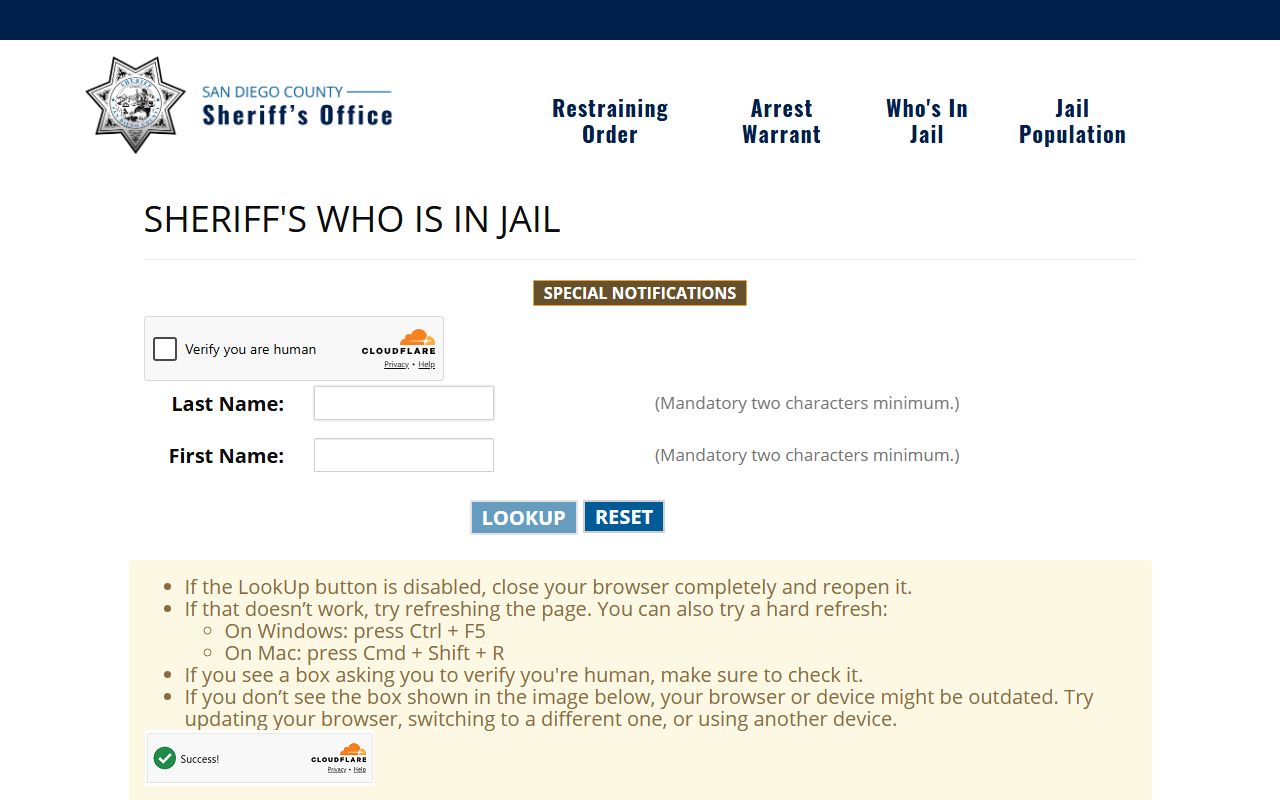
The Who's In Jail tool takes a last name and first name, each with a two-character minimum, plus a Cloudflare check. The Sheriff warns that release dates may not be accurate and the data should not be used for legal action. For the full roster details, see San Diego County inmate records. For active warrants from San Diego Superior Court, the Sheriff runs a public query at apps.sdsheriff.net/WARRANT/waar.aspx.
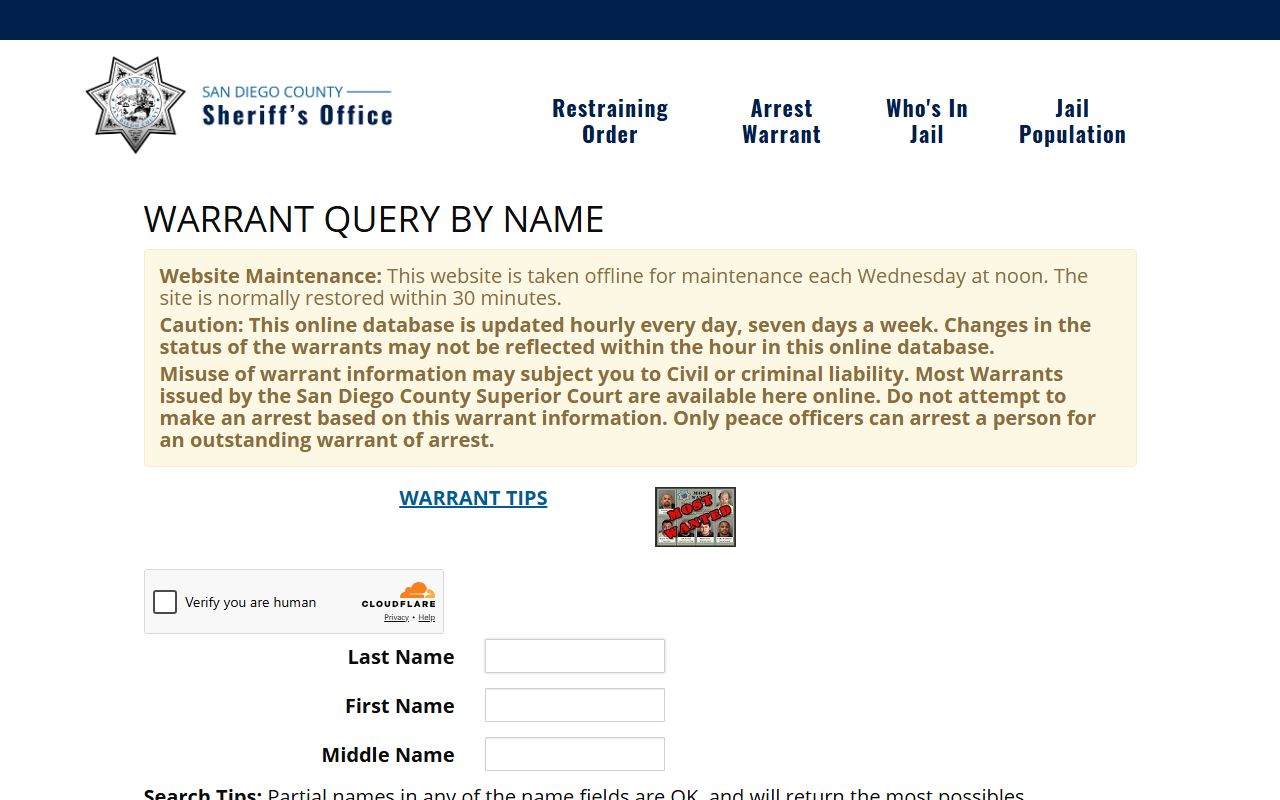
The warrant query above accepts partial names. Only peace officers can arrest on an outstanding warrant. For the full process, see warrant records. Jail population numbers update on the jail population data page, and the released inmates page covers VINE alerts and state and federal release lookups.
Marriage, Divorce, and Probate Records
Marriage licenses and certificates are handled by the San Diego County Assessor/Recorder/County Clerk, also called ARCC. The elected clerk is Jordan Z. Marks. Divorce records are not at ARCC. They are Superior Court family records. To find a divorce file, search the Court Index under Domestic, then use the Family ROA at roasearch.sdcourt.ca.gov. Probate is a division of the Superior Court at the Central Courthouse, phone (619) 844-2676. For the full process, see marriage and divorce records and probate records. The Recorder also keeps deeds, fictitious business names, and birth and death certificates.
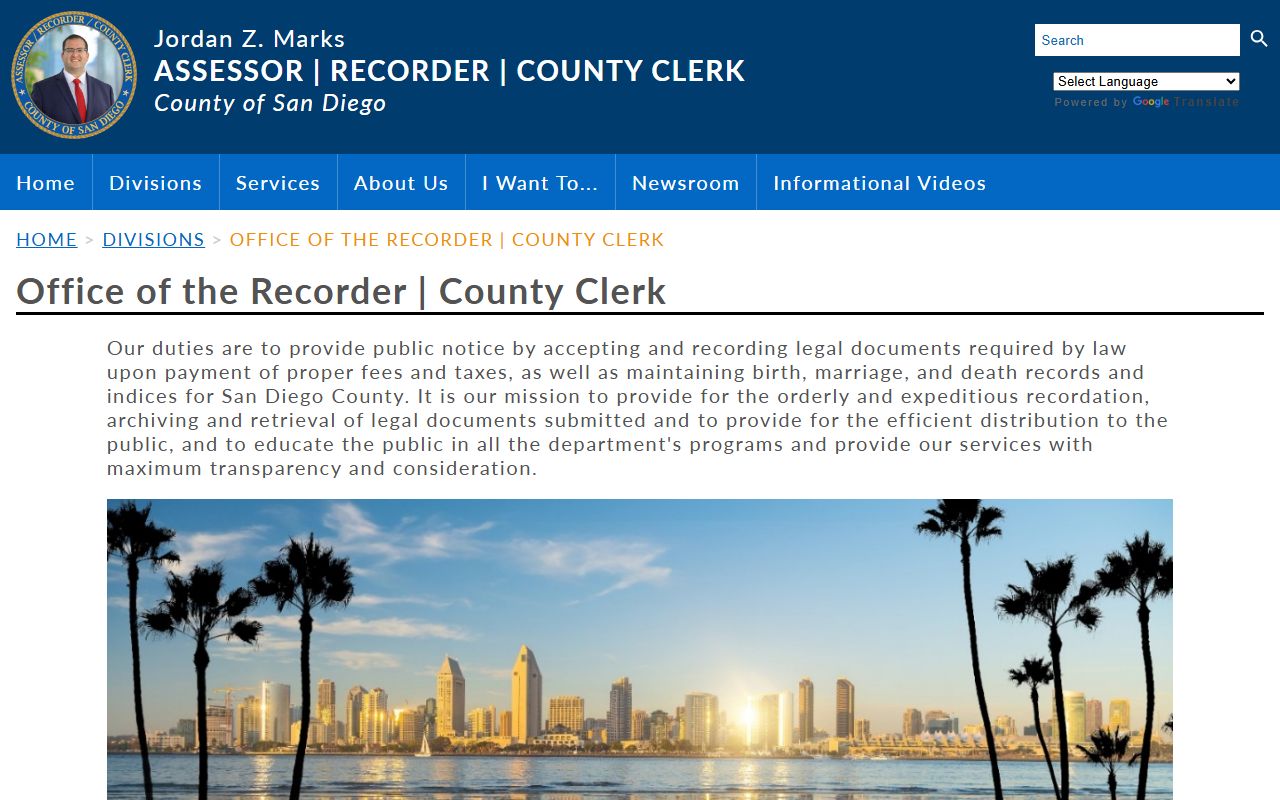
The ARCC page lists every service the office provides, from civil marriage ceremonies to military discharge filings. For more, see the public records page.
- Testator
- The person who writes a will and whose estate is handled in probate after death.
- Executor
- The person named in a will to manage the estate, file the case, pay debts, and give out assets.
- Conservator
- A person the court names to make personal or financial choices for an adult who cannot manage on their own.
- Guardian
- A person the court names to care for a minor's person or estate.
- Intestate
- Dying without a valid will, which makes state law set how the estate is split.
- Petitioner
- The party who files a petition in probate, family, or juvenile court.
San Diego County Court Records Fees
Most case docket viewing is free. Buying a copy is not. ROA charges per page for imaged docs. The Recorder/County Clerk has a separate fee list for marriage and recorded docs. The table below pulls fees from the court's ROA info page and the ARCC fee sheet.
| Item | Amount |
|---|---|
| ROA document copy, first 5 pages | $1.00 per page |
| ROA document copy, each additional page | $0.40 per page |
| ROA document copy, maximum per document | $50.00 |
| Copy from microfiche, microfilm, or file | $0.50 per page |
| Non-party record search over 10 minutes | Search fee under Gov. Code § 70627(c) |
| Public marriage license | $129 |
| Confidential marriage license | $144 |
| Civil ceremony at County Clerk | $107 |
| Certified marriage certificate | $19 |
| Recorded document, first page (non-fraud title) | $14 |
Note: A 2.75% payment service fee will apply to credit, debit, prepaid card, or mobile payment service payments for criminal cases starting July 1, 2026.
How to Interpret San Diego County Court Records
Case files use a lot of short codes. The case number prefix shows the year and case type. CC, TT, and LLL fields in the long format point to case category, case type, and location. ROA event lines may use abbreviations like CMC for case management conference, OSC for order to show cause, or MO for minute order. A charge code on a criminal docket points to a state statute, not to a plain-English crime name. The Sheriff suggests using the California Legislative Information site to look up charge codes from warrant data.
A charge is not a conviction. The Court Index shows the charge filed by the District Attorney. The disposition line shows the outcome: convicted, acquitted, dismissed, or reduced. A guilty plea to a lesser count is common and the docket will show the change. Bench warrants come up after a failure to appear, and they stay active until the court recalls them. Probation status, fines paid, and any case-clearing petition under Penal Code section 1203.4 or 851.91 also show on the docket.
Accuracy and Record Limitations
San Diego court data updates almost in real time once a clerk enters it. Minute orders post after midnight on the date finalized. Imaged docs go online once the imaging step runs. The Sheriff warrant database refreshes hourly, and the Who's In Jail page may show release dates that are still being recalculated. Civil Division is also working through a backlog tied to a new case management system, so some filings may not appear right away. Old files get destroyed under set state schedules: infractions after three years, misdemeanor traffic after five, and misdemeanor DUI after ten.
Note: Always confirm any case detail with the clerk's business office at the court site that has the file before relying on it for a legal action.
History of San Diego County Courts
The Central Courthouse opened in late 2017 as the county's modern hub. It was the largest project funded under California's Senate Bill 1407 court construction program. It replaced older downtown court space and pulled criminal, probate, family, appeals, and administration into one site. The Hall of Justice opened in March 1996 and still holds the Civil Independent Calendar courtrooms, the Civil Business Office, and the Small Claims Business Office. The Sheriff, Probation, and DA also keep offices there.
San Diego Central Jail opened in May 1998 next door to the court complex. It is 230 feet tall with 11 floors and 17 levels. The Sheriff calls it the tallest project the county has ever built. The new Las Colinas Detention and Reentry Facility opened in August 2014 and replaced the old 1967 site, which had served as a juvenile facility before it became a women's jail in 1979. East Mesa was renamed in 2014 to reflect its reentry mission. The court's Older Records section at Central holds case indexes back to 1880, with hardbound books up to 1964 and computer-generated indexes after.
Frequently Asked Questions
How do I find a San Diego Superior Court case number?
Use the Court Index at courtindex.sdcourt.ca.gov/CISPublic/enter. You can search by party name, by case number, or by DA case number. The party search lets you pick case type, court location, party type, a filed-year range, and date of birth. The court warns that the system limits how many results it returns, so more detail makes a case easier to find. Results show the case title, case number, court location, case type, file date, and parties.
Can I view criminal case documents online?
Mostly no. The court says criminal case docs are only available to view in person at the courthouse where the case was heard, or to buy as mailed copies. For criminal cases filed on or after February 17, 2026, some docs can be bought online and mailed, but online viewing and download are still off limits. To read a file, go to the business office records counter at the right branch with photo ID and the case number.
What is the Register of Actions?
The Register of Actions, or ROA, is a case's filing and scheduling record. It can show case details, parties, hearings, and a filing summary. San Diego runs one ROA for civil, small claims, probate, and criminal cases, and a second ROA for family cases. Viewing the summary is free. Imaged docs cost $1 per page for the first five pages, $0.40 for each more page, and a maximum of $50 per doc.
Where are San Diego divorce records?
Divorce records are Superior Court family records, not Recorder/County Clerk records. ARCC says it does not hold divorce records. Search the Court Index under case type Domestic, note the case number and location, then use the Family ROA at roasearch.sdcourt.ca.gov for imaged cases filed on or after August 24, 2015. For older cases, mail a copy request to the court site that heard the case.
How do I search current inmates?
Use the Sheriff's Who's In Jail at apps.sdsheriff.net/wij/wij.aspx. The form needs last name and first name, each with a two-character minimum. A Cloudflare check may show up. The Sheriff warns that data should not be used for a legal action and release dates may not be current. Call (619) 409-5000 to confirm custody, and use VINE for release alerts.
Are juvenile records public?
No. San Diego says all juvenile court records are confidential. The minor, parents or legal guardians, and attorneys of record may get selected records in person with photo ID. Anyone else generally must file Judicial Council form JV-570 and get a court order. The court does not mail juvenile records to outside parties. Adoption files run through Juvenile Court and are also closed to general public access.
What happens to old San Diego court records?
San Diego keeps older indexes at the Central Older Records area. Indexes from 1880 to 1964 sit in large hardbound books. Post-1964 indexes are computer-generated. Older files may also be destroyed under Government Code sections 68152 and 68153. Pre-1974 cases are not on the Court Index, so a researcher needs to visit the court site where the case was heard. Pull more from the San Diego County Court Records FAQ page.
How do I get a public defender?
The court appoints counsel for qualifying criminal cases. The county runs four independent offices: Primary Public Defender, Alternate Public Defender, Multiple Conflicts Office, and Office of Assigned Counsel. The central Public Defender phone listed by the court is (619) 338-4700, with branches at (760) 945-4000 in North County, (619) 579-3316 in East County, and (619) 498-2001 in South County. Paul A. Rodriguez leads the Department of the Public Defender.
More answers on the San Diego County Court Records FAQ page. For court office contacts, see the Superior Court page and the Clerk of the Superior Court page. For everyday public records that the court does not hold, see public records and the about page.