
The California Public Records Act
California Government Code section 7920.000 starts the California Public Records Act, or CPRA. It declares public records open to the public unless a clear exemption applies. The law was recodified in 2023 and now lives in Division 10 of the Government Code. Any state or local agency that makes, keeps, or uses a record is covered. Counties, cities, special districts, and the offices that report to them all sit under the law.
The CPRA text is on the legislature site at leginfo.legislature.ca.gov. A record may be a paper file, an email, a database row, a spreadsheet, a body-cam clip, a GIS layer, or anything else kept by an agency. The form does not matter. The use does not matter. Public access turns on whether the file is in the agency's hands and whether a statute exempts it.
The CPRA short title at leginfo shows the structure of the act and the long list of cross-references to exemptions. Most requesters never read past the first few sections. The full text matters when an agency claims an exemption and the requester wants to test it.
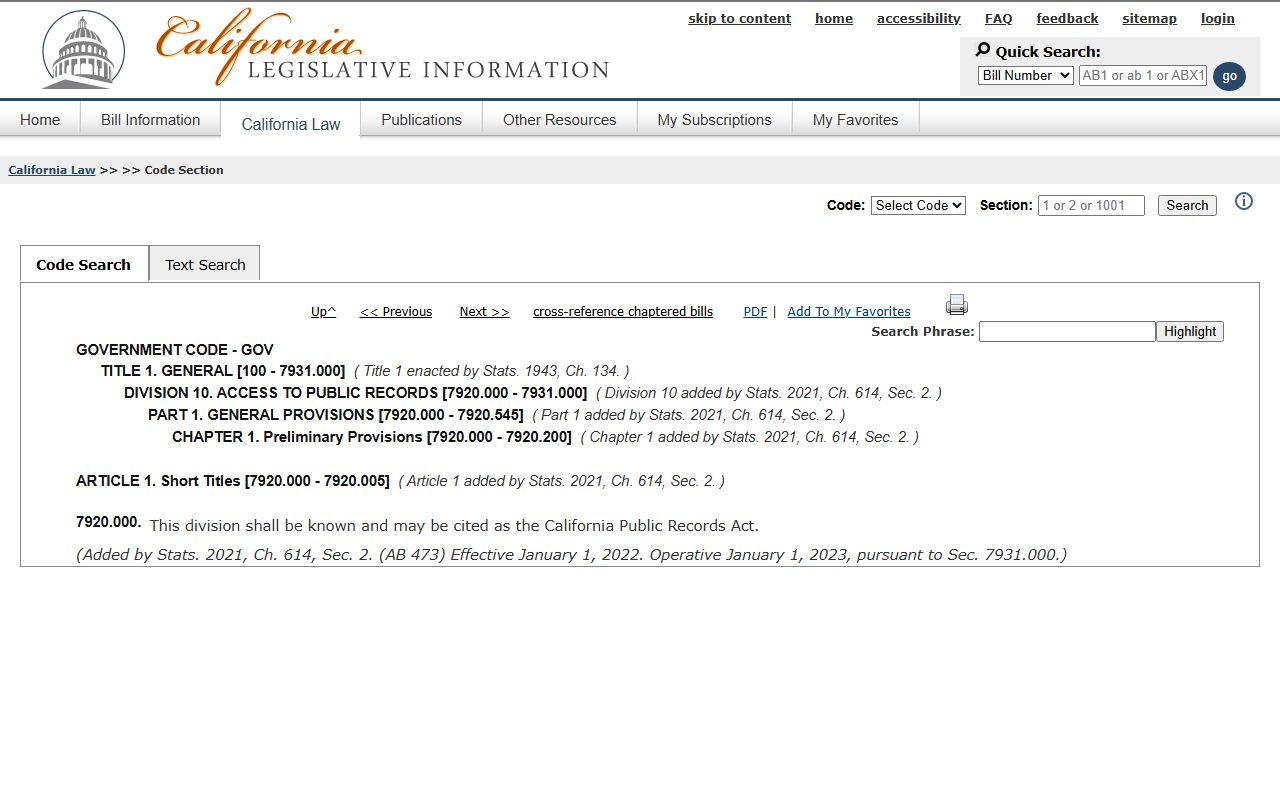
The page above is the statute's home base. Each agency's own CPRA portal will quote a slimmer version, but the law itself controls. When in doubt, go to the source.
CPRA Process and Timelines
An agency must answer a CPRA request within 10 calendar days. The answer is not always the records. It must say whether the agency holds responsive files and whether it will produce them. If the agency needs more time, it may take a one-time extension of up to 14 days for unusual cases, such as a large search or a need to consult another office. The full clock then runs out at day 24.
Note: An agency may not use the extension to dodge the 10-day reply. It must still answer in writing within the first 10 days and explain why more time is needed.
If the agency decides to release records, it must do so promptly. Production may happen by mail, by email, on a portal, or in person. The agency may not charge for the search time, only for direct copy costs and for set statutory fees. If the agency denies the request, it must point to the statute or rule that allows the denial. The denial must be in writing.
What Counts as a Public Record
The CPRA reads "public record" broadly. Any writing kept by an agency in the conduct of public business is a public record. Drafts, notes, emails to and from staff, meeting calendars, contracts, invoices, complaints, inspection reports, and policy memos all count. So do photos, video, audio, and database records. The list below is a sample of files that are open in San Diego County agencies under normal rules.
- Board of Supervisors agendas, minutes, and supporting documents.
- Contracts, invoices, and payment records of county departments.
- County employee salary tables and job classifications.
- Inspection reports from Environmental Health and Animal Services.
- Permit files at Planning and Development Services.
- Sheriff department policies, training materials, and crime statistics summaries.
San Diego County Agencies and Records They Hold
San Diego County is a large local government. Many offices have their own records desk. The table below maps the most common record types to the right agency. Court records sit under a different rule set, but they are included for routing.
| Record | Agency | Path |
|---|---|---|
| Recorded deeds, liens, official records | Assessor/Recorder/County Clerk (ARCC) | Acclaim portal and counter visit |
| Birth, marriage, and death certificates | ARCC, Recorder/Clerk Division | Application by mail or in person |
| Fictitious Business Names | ARCC, Recorder/Clerk Division | Counter filing and Acclaim search |
| Court case files | Superior Court | Court Index and ROA; see court records |
| Arrest reports, jail records | San Diego Sheriff | Sheriff CPRA portal |
| County contracts, budget files | Department of General Services and others | County CPRA portal |
| Property tax rolls and parcel data | ARCC, Assessor Division | Public counter and online lookup |
How to File a San Diego County Public Records Request
A clean request gets a quick reply. A vague request draws a long delay or a denial. The steps below cover the standard path used by most county agencies. The Sheriff and the ARCC each run their own portal, but the steps below still apply.
- Identify the agency that holds the file. Call ahead if unsure.
- Describe the records in plain terms. Use dates, names of staff, project names, and case numbers when known.
- Pick the format you want. PDF by email is the cheapest path. Paper costs more.
- Send the request through the agency's CPRA portal, by email, or by mail.
- Wait for the 10-day reply. The reply will name a contact and a next step.
- Read any cost estimate. Approve the work before the agency starts copying.
- Pay the bill on delivery. Pick up the file or open the secure download link.
Note: You do not have to say why you want the file. The CPRA forbids agencies from asking. A use statement may help in a fee waiver request, but it is never the basis for denial.
How to Request Records From the Sheriff
The San Diego County Sheriff's Office runs a CPRA portal that handles arrest reports, jail records, body-worn camera, dispatch logs, and policy files. Arrest reports may be partly redacted under privacy law and under Penal Code rules that protect victims, juveniles, and informants. SB 1421 and SB 16 carved out a wider release of peace officer use-of-force and misconduct records.
Use the case number when you have it. If you do not, give the date, the location, and the names of any parties. The Sheriff will route the request to the right unit. Body-cam clips draw a redaction fee and a long delay. Plan for weeks of work on a video request. For the Sheriff's role in custody records, see court records. For broader court file rules, the section below covers the courts.
Court Records Are Different
California court files are not CPRA records. They are court records under the California Rules of Court. Rule 2.400 sets the right of the public to inspect court papers in the clerk's office. Rule 2.503 controls electronic access to trial court records. Rule 2.550 says court records are open unless sealed or made confidential by law. The Court Index and ROA are part of the system that Rule 2.503 calls for.
The rule text is on the Judicial Council site. Read Rule 2.400 for the basic right of access at the clerk's counter.
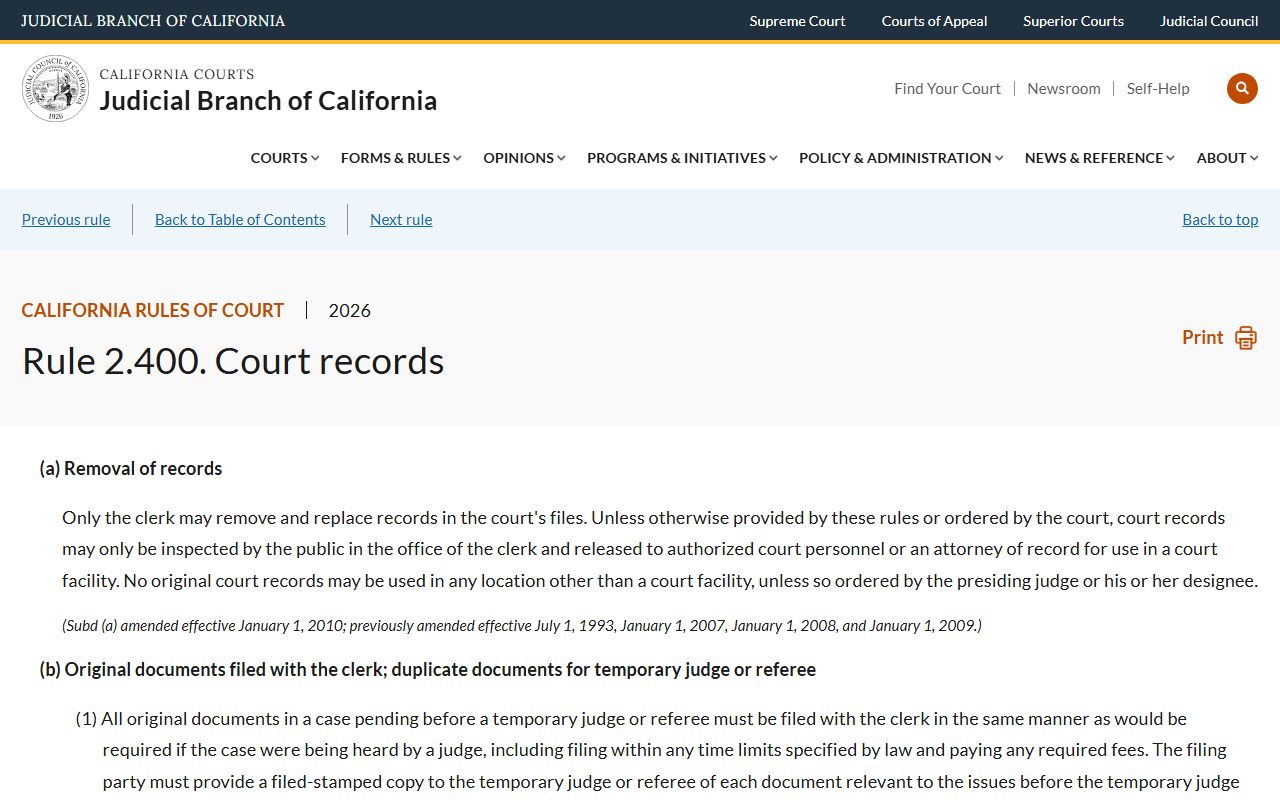
Rule 2.400 is short and clear. It says court papers may be inspected in the clerk's office by any person during business hours, except for files made confidential by law or by order.
For online access, Rule 2.503 is the controlling rule.
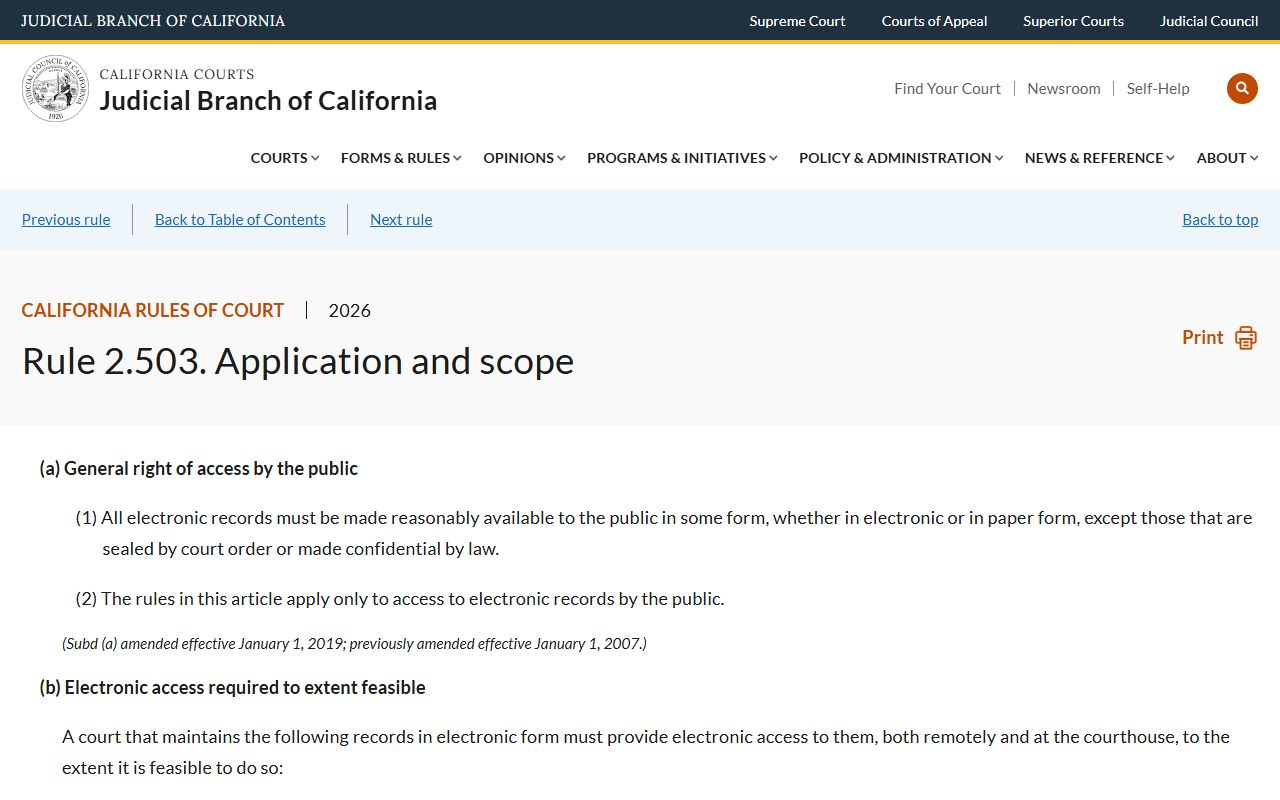
Rule 2.503 limits remote access for criminal, family, juvenile, and mental health case documents. That is why probate records are partly online, while criminal documents must be viewed in person.
ARCC Recorded Documents and the Acclaim Portal
The San Diego County Assessor/Recorder/County Clerk runs the Acclaim search at arcc-acclaim.sdcounty.ca.gov. It covers recorded official records such as deeds, deeds of trust, liens, releases, notices of default, and reconveyances. The current Recorder/County Clerk is Jordan Z. Marks. Search tiles include By Book/Page, By DocType, By Number, By Name, By Date, and By Map Number. The APN search came off the public web in late 2024 under AB 1785 and is now only available at in-person kiosks.
The ARCC also holds birth, marriage, and death certificates for San Diego County. Vital record copies are not free. Each certified copy carries a state fee. The office does not hold divorce decrees or adoption orders. Those are court files. For a divorce decree copy, use the marriage and divorce records page and the Superior Court family records office. The Clerk of the Superior Court page covers the court clerk's role.
ARCC Main Office
1600 Pacific Highway, Suite 260
San Diego, CA 92101
(619) 237-0502
Monday through Friday, 8:00 a.m. to 5:00 p.m.
What to Put in a CPRA Request Letter
A request letter does not need a special form. Most agencies accept plain email. The table below shows the fields that move a request along quickly. Required fields are the ones the agency needs to act. Optional fields help the agency cut the cost and the delay.
| Field | Required | Notes |
|---|---|---|
| Requester name | No | An agency may not require a name to release public records, but a name speeds delivery. |
| Organization | No | Optional. Helps the press desk route media requests. |
| Mailing address | No | Needed for paper delivery only. |
| Email address | No | Strongly suggested. PDFs come back faster on email. |
| Phone number | No | Lets the analyst call to narrow a vague request. |
| Description of records | Yes | Use dates, names, project IDs, and case numbers if known. |
| Date range | No | Cuts the search workload and the bill. |
| Format preference | No | PDF by email is the default. Native files cost more. |
| Fee waiver request | No | Only some agencies offer waivers for public interest use. |
Fees for Public Records and Certified Copies
The CPRA limits agency charges to the direct cost of duplication. There is no charge for the time staff spend looking for the record. Court records have a different fee set under the Uniform Civil Fees law and Government Code section 70627. Certified copies and name searches have their own fixed amounts. The table below shows common San Diego County fees.
| Item | Amount |
|---|---|
| Plain paper copy, per page (CPRA, direct cost) | $0.10 to $0.50 |
| Plain paper court copy, per page | $0.50 |
| Certified copy of a court document | $40 first document, $0.50 each added page |
| Court record name search (over 10 minutes) | $15 per name, per Government Code section 70627 |
| Recorder first-page recording fee, non-fraud title | $14 |
| Recorder first-page recording fee, real-estate-fraud title | $17 |
| Certified marriage certificate (ARCC) | $19 |
| Public marriage license (ARCC) | $129 |
| ROA imaged court document, first five pages | $1.00 per page |
| ROA imaged court document, added pages | $0.40 per page (cap $50) |
Note: Court file retention is set by Government Code section 68152. A file may be destroyed after the stated retention period. If a file is gone, no copy can be made.
Denials and Appeals
An agency may deny part or all of a request. The denial must point to the statute that allows it. Common grounds include personnel privacy, attorney work product, draft documents that have not been used to take final action, ongoing law enforcement investigation files, juvenile records under Welfare and Institutions Code section 827, and sealed court files under Rule 2.550.
If the denial is wrong, the requester has two paths. The first is informal. Write back, point out the error, and ask for review by a supervisor or by counsel. Many denials are fixed at this step. The second path is a civil suit under the CPRA. A court may order the file released and may award attorney fees to the winning party. The state Attorney General also writes opinion letters on CPRA matters that often guide agency staff. For court files, the right path is a motion to unseal or a request to a presiding judge under Rule 2.551.