
How to Search San Diego Probate Records
San Diego Superior Court runs a two-step search for probate cases. The Court Index finds the case number and the branch holding the file. The Register of Actions, or ROA, then opens the case page with parties, hearings, probate notes, and the list of filings. Both tools are free to view. Some imaged documents may be bought for a fee.
The Court Index sits at courtindex.sdcourt.ca.gov. The probate ROA sits at odyroa.sdcourt.ca.gov. A clean source for the Probate Division itself, with hours, forms, and contact lines, is the court's Probate Division page.
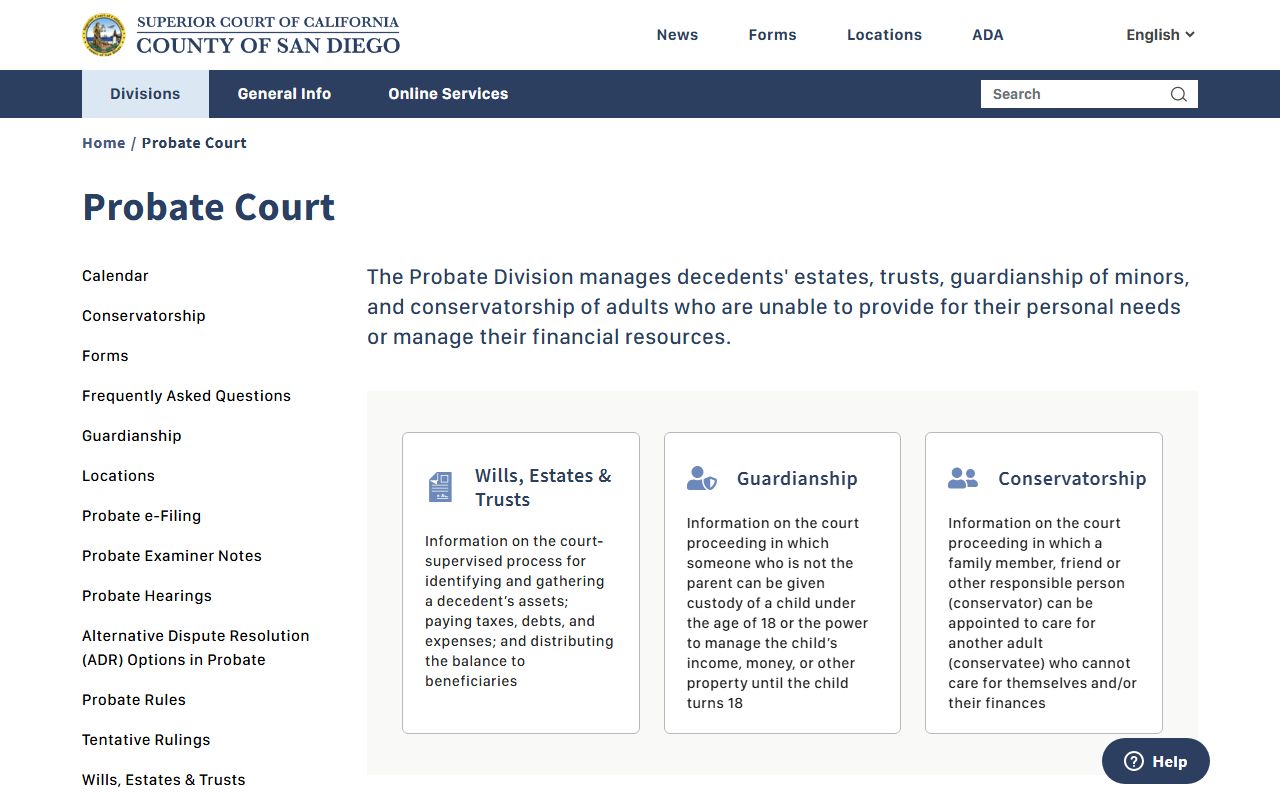
The Probate Division page covers the Business Office hours, the will deposit service, the probate examiner phone slot, and the copy request form used for mail orders. Most users start there before they touch the ROA.
- Open the Court Index and pick Party Name Search or Case Number Search.
- Set the case type to Probate. Set the location to San Diego or Unknown-All.
- Enter the last name of the decedent, ward, or conservatee. A first name speeds the match.
- Note the case number and case branch from the result list.
- Open the probate ROA and run a Case Search using the case number.
- Read the filing list, the probate notes, and any tentative ruling.
- Buy imaged documents online, or order paper copies on form PR-189.
The Probate Court at Central Courthouse
San Diego has a Probate Division inside the Superior Court. There is no separate probate court. All probate, trust, guardianship, and conservatorship work runs through one Business Office downtown. Files older than current matters may also sit in the Central Division Older Records area on the 14th floor.
The case flow for probate appeals runs Superior Court › Court of Appeal (Fourth District, Division One) › Supreme Court of California. The trial-level work, where wills are proved and estates are opened, sits at the Central Courthouse on Union Street. The Superior Court page covers the full court layout, while the Clerk of the Superior Court page covers court-wide filing rules.
Probate Business Office, Central Courthouse
1100 Union Street
San Diego, CA 92101
(619) 844-2676
Monday through Friday, 8:30 a.m. to 4:00 p.m.
Note: Probate examiners are on the phone 10:00 to 10:30 a.m. weekdays. Use email for non-urgent case questions. The Business Office takes will deposits in person any working day during counter hours.
What Probate Covers
Probate in San Diego covers the wind-down of an estate when a person dies, the care of a minor child without a parent, and the care of an adult who can no longer manage personal or financial needs. Trusts and trust disputes also sit here. The Division handles four broad case groups.
- Decedents' estates: wills, probate of wills, administration with or without a will, creditor claims, inventories, accountings, and orders for final distribution.
- Trusts: trust petitions, instructions to a trustee, removal of a trustee, and trust accountings.
- Guardianships of a minor: guardianship of the person, guardianship of the estate, and changes or terminations.
- Conservatorships of an adult: probate conservatorships, limited conservatorships for adults with developmental needs, and Lanterman-Petris-Short conservatorships handled in coordination with mental health.
- Will deposits for safekeeping: Probate Code section 8200 deposits by a person who holds the will of a living testator.
Key Probate Terms
Probate uses words that show up rarely in daily speech. The short list below covers the terms you will see in San Diego probate files and court forms.
- Testator
- The person who made the will. A woman may also be called the testatrix in older files.
- Executor
- The person named in a will to carry out the estate. The court issues Letters Testamentary to give the executor power to act.
- Administrator
- The person named by the court to wind up an estate when there is no will or no named executor. The court issues Letters of Administration.
- Intestate
- Dying without a will. State rules of intestate succession then decide who inherits.
- Letters Testamentary
- The court order that gives an executor power to gather assets, pay debts, and pass property to heirs.
- Letters of Administration
- The same kind of order, but for an administrator in a no-will case.
- Guardianship
- A probate arrangement for the care of a minor child or a minor's estate when a parent cannot serve.
- Conservatorship
- A probate arrangement for an adult who can no longer make safe choices about person, finances, or both.
How Probate Works in San Diego County
Most probate cases move through the same series of steps. The court calls these stages. Petitions start the case. Letters give the personal representative power. Notice runs to heirs and creditors. The estate is gathered, debts are paid, and the rest passes by order.
- Decide if a probate, trust, guardianship, or conservatorship petition is the right tool.
- File the petition at the Central Courthouse Probate Business Office, or through an approved e-Filing Service Provider.
- Set the first hearing on the probate calendar. The clerk gives the date and the department.
- Send notice to heirs, beneficiaries, and known creditors as the code requires.
- Read the probate examiner's notes. Fix any defects before the hearing.
- Attend the hearing. The judge issues Letters to the personal representative.
- Collect estate assets, take an inventory, and value the property.
- Pay valid claims and taxes. File the accounting.
- File the petition for final distribution. The judge signs the order, and the property passes to the heirs.
Note: Tentative rulings and probate notes are free to read on the ROA. Use them before the hearing to spot missing signatures, missing notice proofs, or wrong fee calculations.
Probate Filing Fees
California probate fees follow a statewide schedule under the Uniform Civil Fees law. San Diego applies the same base fees as every other county. The most common first-filing fee for a decedent's estate or a trust petition is $435. Copy and certification fees are set by the same statute and by court order.
| Item | Amount |
|---|---|
| First petition for probate of a will or for letters | $435 |
| First petition by an objector or other party | $435 |
| Trust petition under Probate Code section 17200 | $435 |
| Guardianship or conservatorship petition | $435 |
| Petition for a small estate set-aside | $200 |
| Will deposit for safekeeping under Probate Code section 8200 | $20 |
| Certified copy of a court document | $40 first document, $.50 each added page |
| Plain copy, per page | $0.50 |
| ROA imaged document, first five pages | $1.00 per page |
| ROA imaged document, each added page | $0.40 per page (cap $50 per document) |
Fee waivers are open to low-income filers on Judicial Council form FW-001. The Business Office reviews each waiver before the first hearing. A statutory probate fee for the personal representative's services and the attorney's services is set by Probate Code section 10800 and 10810 and is paid out of the estate, not at filing.
Will Deposits for Safekeeping
Probate Code section 8200 lets the holder of the will of a living person deposit it with the court for safekeeping. The Business Office at Central takes deposits during regular counter hours. The fee is set by statute. The will stays sealed in the court's custody until the testator dies, at which point the named executor or another person with legal interest may file to open the estate.
Bring the original will, photo ID, and a check or cash for the deposit fee. Staff give a receipt with the deposit number. Keep that receipt with your other estate papers. The court does not draft wills or give legal advice on what a will should say. For drafting help, contact a probate attorney or the San Diego Volunteer Lawyer Program.
Conservatorship and Guardianship
San Diego conservatorship cases go through a court investigator before any order. The investigator interviews the proposed conservatee, reads the medical record, and writes a report for the judge. The same office runs follow-up visits during the case. Guardianship of the estate cases also draw an investigator. Guardianship of the person cases follow a different track that often includes Family Court Services.
Conservatorship case types in San Diego include the probate conservatorship for an adult with cognitive decline, the limited conservatorship for an adult with a developmental disability, and the Lanterman-Petris-Short conservatorship for an adult with a grave mental health condition. The first two run in the Probate Division. The LPS path runs in coordination with mental health calendars and the Public Conservator. Sealed mental health steps inside an LPS case are not on the public ROA.
Probate Examiners and Probate Notes
Each pending case in San Diego draws a probate examiner. The examiner reads the petition, the notice proofs, the bond, the inventory, and any objections. The examiner then writes probate notes. The notes flag missing items, wrong dates, math errors in the accounting, and other defects. Both petitioner and counsel may read these notes on the ROA before the hearing. Fixing each item early often saves a continued hearing.
Examiners take calls from 10:00 a.m. to 10:30 a.m. on regular court days. Email is open all day. The court asks that callers have a case number ready and not call about a case where probate notes have not yet posted. Tentative rulings, when used, post the day before the hearing and may be free to read on the same ROA case page.
Restrictions on Public Access
Most probate filings are open to the public. Wills become public on filing. Inventories, accountings, and orders are open as well. Some pieces of a probate case are not open. The court keeps guardianship and conservatorship documents off the public ROA under California Rules of Court. Confidential medical reports filed in a conservatorship are sealed by statute. Adoption files, though sometimes routed through related calendars, are confidential under Family Code rules and are not on the probate ROA.
Public access at the courthouse is wider than online access. A person may view most probate files at the records counter with valid photo ID and the case number. Staff pull up to ten files per visit. Photographs of file contents are not allowed. Phones and other cameras must stay in your pocket while the file is open. For broader rules on public files in California, see the public records page.