
Criminal Records in San Diego County
San Diego County criminal records are split across three offices. The Sheriff books people into one of seven county jails and lists current custody on the Who's In Jail database. The Superior Court opens a criminal case once the District Attorney files charges, and the Clerk of the Superior Court keeps the docket. Police departments in cities like San Diego, Chula Vista, and Oceanside hold their own arrest reports, but the official court file lives with the Superior Court. Criminal matters are heard at the Central Courthouse, the North County Regional Center in Vista, the East County Regional Center in El Cajon, and the South County Regional Center in Chula Vista.
It helps to know the difference between an arrest record, a court record, and a conviction. An arrest record is created at booking and shows charges the police suspect. A criminal court record starts when the DA files an accusatory pleading and includes pleadings, motions, hearings, and the final outcome. A conviction record reflects only the final result, after a plea or verdict. Each type lives in a different system. Each has its own access rules. Mixing them up leads to the wrong search.
How to Search San Diego County Criminal Records
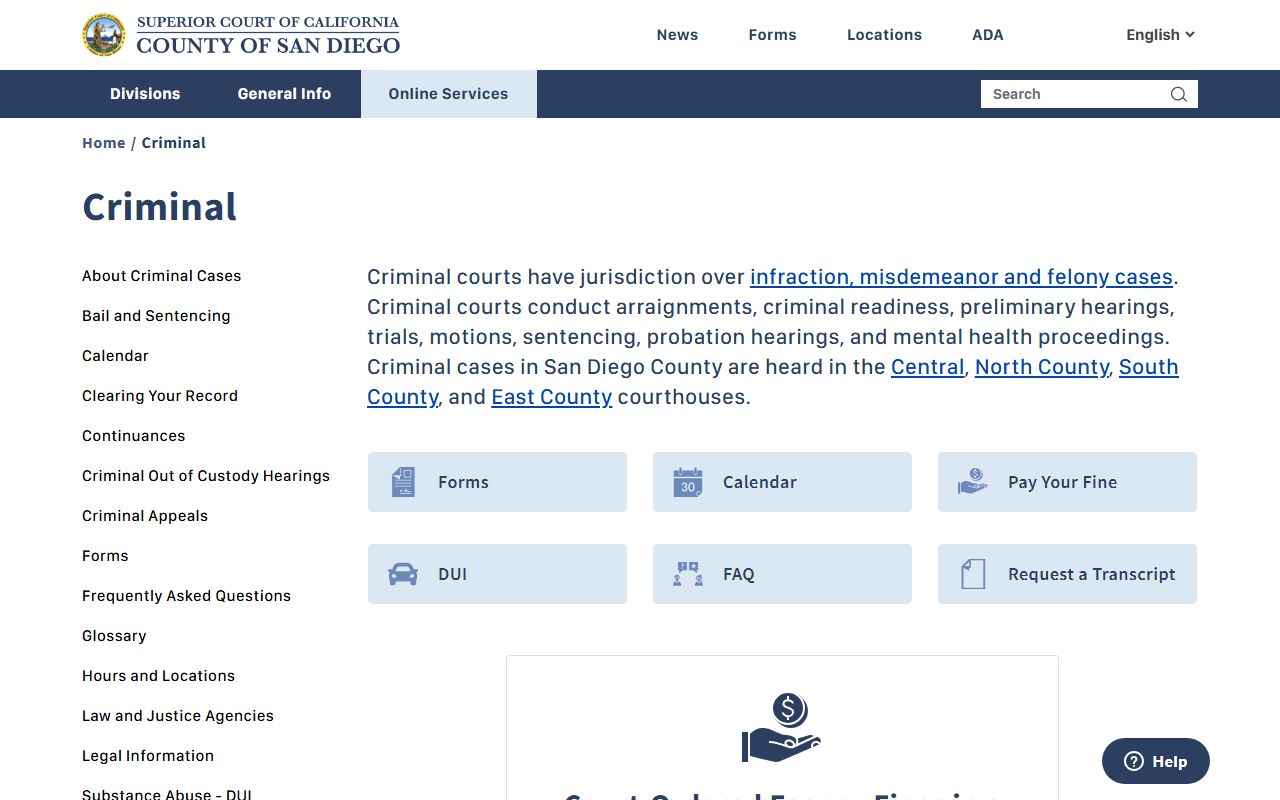
The court's main public search is the Court Index. Three search modes are open to the public: Party Name Search, Case Number Search, and DA Number Search. The Criminal Division explains the larger process at sdcourt.ca.gov/sdcourt/criminal2, which covers arraignment, motions, sentencing, and warrants in one place.
The Superior Court Criminal Division page walks through felony, misdemeanor, and infraction handling.
Pair the Court Index with the Sheriff's Who's In Jail tool for current custody, and the DA's Office for charging decisions. The court warns that civil limited and misdemeanor records may be online for only 10 years at some sites.
- Open the Court Index and pick the search type. Use Party Name Search if you only have a name. Use Case Number Search if you have the file number.
- Set Case Type to Criminal. Pick a Case Location (Central, North, East, South, Kearny Mesa, Ramona, or Unknown-All).
- Type a last name (more letters help). Add a first name and date of birth to narrow results. The court limits the total result set.
- Note the case number, location, file date, and parties. Use that data to view the file in person or order copies by mail.
The Court Index returns case title, case number, location, type, file date, and parties. Criminal documents are not viewable online. Files are read in person at the business office where the matter was heard, or copies are mailed after a written request with payment and a self-addressed stamped envelope.
DA Number Search and Court Index Tools
Criminal cases in San Diego have a District Attorney case number that runs in parallel with the court case number. If you only have the DA number, head straight to the DA Number Search on the Court Index. It is the fastest path when a charging letter or DA correspondence shows the DA number but not the court case number.
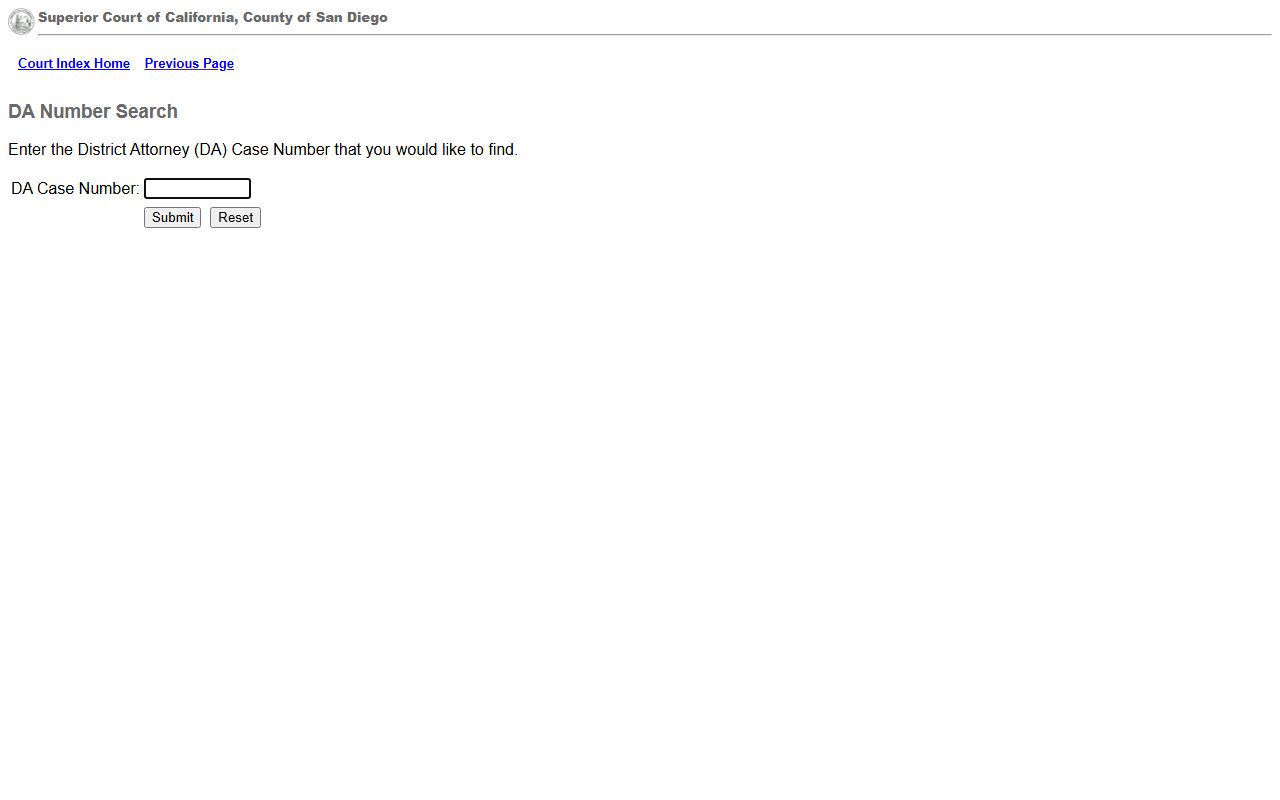
The DA Number Search returns the matching court file with case title and location. From there, use the Register of Actions for civil/small claims/probate/criminal at odyroa.sdcourt.ca.gov to view filing summaries. Note that some criminal documents may be purchased online and mailed for cases filed on or after February 17, 2026, but online viewing is still blocked for most criminal files.
Felony vs Misdemeanor vs Infraction
California sorts criminal offenses into three tiers. Each tier has its own court process, sentence range, and record consequences. A felony is the most serious. It carries a state prison term or county jail under realignment. Murder, robbery, and serious drug trafficking sit here. A misdemeanor carries up to one year in county jail. DUI, petty theft, and many domestic violence counts fall in this group. An infraction is the lowest tier, a non-jailable violation that ends in a fine. Most traffic citations are infractions.
San Diego's Criminal Division handles all three. The pretrial steps look similar, but the file paths and post-conviction relief paths differ. A "wobbler" is a charge that may be filed either as a felony or as a misdemeanor, depending on facts and the DA's discretion under Penal Code section 17(b). Some cases can be reduced from a felony to a misdemeanor at sentencing, which then opens up record relief that would not be available for a straight felony.
What Is in a San Diego County Criminal Record
A San Diego County criminal record holds more than just the charge. The file shows the people, the dates, the rulings, and the result. The sample table below lists the core fields that appear in the Court Index and the Register of Actions.
| Field | What It Shows |
|---|---|
| Case Number | Format is XX-YYYY-########-CC-TT-LLL. Shortcut entry is YYYY######## without dashes. |
| Case Title | Caption, usually People v. [Defendant], or short party name. |
| Case Location | Central, North County, East County, South County, Kearny Mesa, or Ramona. |
| Date Filed | Date the DA filed the charging document. |
| Charges | Penal Code section, count, and degree (felony, misdemeanor, infraction). |
| Hearings | Arraignment, readiness, prelim, motions, trial, sentencing. |
| Disposition | Final or current outcome of each count. |
| Sentence | Custody, probation, fine, restitution, conditions. |
| Bail / Bond | Cash, bond, or own recognizance status. |
| Warrants | Any bench or arrest warrant tied to the case. |
The case may also list DA number, defense counsel (private, Primary Public Defender, Alternate Public Defender, or Multiple Conflicts Office), and any tied protective orders. Sensitive fields like victim identity or juvenile co-respondents may be redacted under California Rules of Court rule 2.503 and rule 2.550.
Charges vs Convictions
Being charged is not the same as being convicted. A charge is an accusation the DA files. A conviction is the legal result of a guilty plea, a no contest plea, or a verdict of guilt at trial. Both can show up in a public file, but the meaning is very different.
| Charge | Conviction | |
|---|---|---|
| Stage | DA's accusatory pleading | Plea, verdict, or court finding |
| Burden of Proof | Probable cause | Beyond a reasonable doubt |
| Effect | No legal guilt yet | Legal guilt entered on record |
| Public Record | Yes, in court file | Yes, in court file and DOJ history |
| Background Check | May appear with status pending | Reports as final conviction |
| Relief Path | Sealing under PC 851.91 if dismissed | Dismissal under PC 1203.4 if eligible |
Note: A dismissed charge can still show on a record. Sealing under PC 851.91 is what closes the arrest entry from public view, not the dismissal itself.
Sealed vs Expunged Records
California does not use the word "expungement" the way other states do. The state offers two main paths. One is sealing an arrest under Penal Code section 851.91. The other is post-conviction dismissal under Penal Code section 1203.4. The Superior Court's Criminal Division has a "Clearing Your Record" resource for both.
| Sealed (PC 851.91) | Dismissed / "Expunged" (PC 1203.4) | |
|---|---|---|
| Applies To | Arrests that did not lead to a conviction | Convictions where probation was completed |
| What Happens | Arrest record sealed from public view | Plea is set aside, case is dismissed |
| Public Visibility | Hidden from most public access | Conviction shown as dismissed |
| Law Enforcement | Still visible for limited uses | Still visible to courts and DOJ |
| Bars on Use | Cannot be used for many private uses | Must still disclose for some licenses and peace officer jobs |
| Filing Court | Court where the arrest case was filed | Court where the conviction was entered |
Juvenile records are governed by Welfare and Institutions Code section 827 and are confidential by default. Authorized persons can review some minutes in person with photo ID. Others must file Judicial Council form JV-570 to ask the court for access.
Mugshots and Booking Photos
Mugshots are booking photos taken at intake. In San Diego County, the Sheriff books most adult arrests through San Diego Central Jail for males and Las Colinas Detention and Reentry Facility for females. The Who's In Jail database at apps.sdsheriff.net/wij/wij.aspx shows custody status, but the public face of the system does not always display the booking photo. Some local police agencies, like Chula Vista PD, retain their own arrest data and may show booking images on their own pages.
Mugshots are public in California in most cases, but the law limits how third-party sites may use them. Under Civil Code section 1798.91.1, a website cannot demand payment to remove a booking photo. That law put many "mugshot for pay" sites out of business. If a booking photo has been wrongly tied to your name or never led to a charge, ask the originating agency to correct the record and consider a PC 851.91 sealing petition.
Public Access Laws for Criminal Court Records
San Diego Superior Court applies California Rules of Court rule 2.400(a), which says court papers can be inspected in the clerk's office, and rule 2.550(a), which presumes court records are open unless sealed by law. Electronic access is narrower. Rule 2.503 requires online access to indexes, calendars, and registers of actions where it is feasible, but it limits remote access for criminal, family, juvenile, and mental health files.
That is why the Court Index returns the case number and parties, but the actual criminal pleadings and motions cannot be downloaded. You can read them in person at the courthouse business office, or pay for mailed copies. Files cannot be removed. Staff pulls up to 10 cases per request, per customer, per trip. Non-party searches longer than 10 minutes may trigger a Government Code section 70627(c) search fee. Copies from microfilm, microfiche, or hard file are 50 cents per page.
Juvenile court records sit under WIC section 827. Sealed adult records sit under PC 851.91. Restrictions on mental health proceedings, gun violence orders, civil harassment matters, and elder abuse files are layered on top.
Background Checks and the California DOJ
The Court Index gives a case-level view of San Diego cases. A statewide criminal history check runs through a different door. The California Department of Justice Live Scan system is the official path. A subject can request his or her own record, and many employers and licensing bodies have authority to request a Live Scan as well. Live Scan uses fingerprints, so it pulls more than name-based searches. It pulls the master Criminal Offender Record Information, sometimes called the RAP sheet.
Important: This site is not a consumer reporting agency under the Fair Credit Reporting Act. Records here may not be used for hiring, tenant, credit, or insurance decisions.
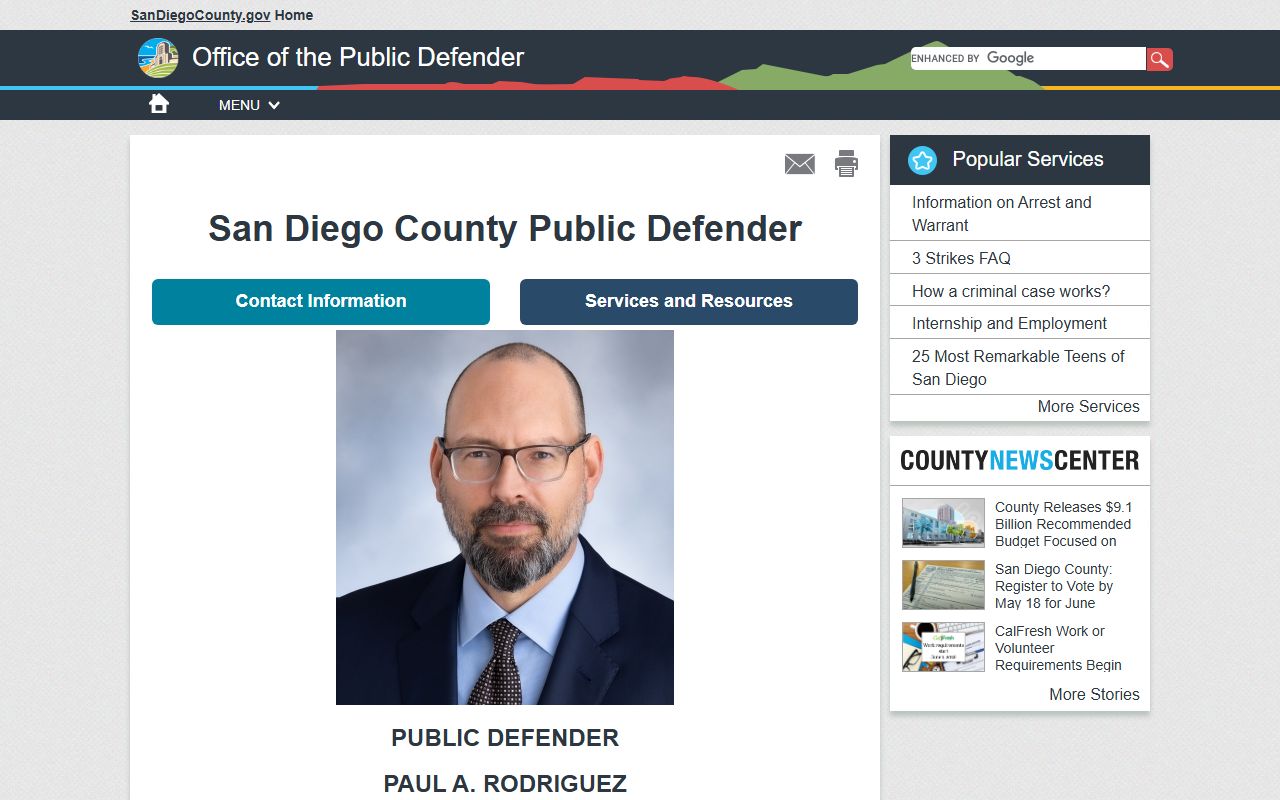
Public Defender services are managed at the county level. The Department of the Public Defender runs four ethically walled offices: the Primary Public Defender, the Alternate Public Defender, the Multiple Conflicts Office, and the Office of Assigned Counsel. Paul A. Rodriguez heads the department.
The Public Defender overview page explains how cases route across the four offices.
For private background screening, hire an FCRA-compliant reporting agency. Statewide sex offender lookups go through the California DOJ Megan's Law site at meganslaw.ca.gov, which is authorized by PC 290.46.
Sheriff and Jail Information
Sheriff Kelly Martinez runs the Detention Services Bureau. Seven detention facilities house more than 5,000 incarcerated persons on a typical day, and the system books about 100,000 people each year. San Diego Central Jail is the main male intake. Las Colinas is the main female intake. East Mesa, George Bailey, Rock Mountain, South Bay, and Vista round out the seven sites.
To find someone in current custody, use San Diego County inmate records. The Who's In Jail tool needs at least two characters in last name and first name. The site goes offline each Wednesday at noon for about 30 minutes for upkeep. Release dates shown can be off while files recalc, so call (619) 409-5000 to confirm. For active warrants, see San Diego County warrant records.
Specialty Courts and Diversion Programs
San Diego Superior Court runs several specialty calendars for criminal defendants who need treatment instead of plain custody. The Substance Abuse Assessment Unit, or SAAU, sits inside the Criminal Division and screens defendants for substance use issues. The Behavioral Health Oversight and Treatment calendar, called BHOT, is run at the South County Regional Center for formal probationers under behavioral health supervision. The CARE Act adds a civil court track for people with untreated schizophrenia spectrum or other psychotic disorders.
DUI cases follow their own track. The DA filings show up on the Court Index, but the post-conviction conditions often pull in DMV. For a deeper view of DUI handling, see San Diego County traffic court records. Many DUI defendants also touch SAAU referrals before sentencing.
Restricted San Diego County Criminal Records
Some criminal files are not open to the public. Juvenile delinquency files under WIC 827 are confidential, and so are juvenile dependency cases. Sealed arrests under PC 851.91 are pulled from public view. Sealed records by court order under CRC 2.550 are not viewable without a separate order. Ongoing investigations are also kept under wraps until the case is filed in court. Federal criminal cases out of the Southern District of California are searched on PACER, not the Court Index.