
How to Find Recently Released San Diego County Inmates
The San Diego Sheriff does not post a "recently released" list. Release dates appear, when they appear at all, inside the live custody profile on Who's In Jail at apps.sdsheriff.net/wij/wij.aspx. Once the system marks an inmate as released, the record may drop off the live list within a short window.
The Sheriff posts a clear warning that release dates shown on the site may not be right while records are being recalculated. So the best move is two-step: check the roster, then call the jail records line at (619) 409-5000 to confirm the time and place of release. Pick the right facility from the phone menu.
For people who left county custody days or weeks ago, switch to the state or federal locators below. A name may move from Sheriff custody to state prison through the California Department of Corrections and Rehabilitation, or to federal custody through the Bureau of Prisons.
VINELink is the most useful free tool for tracking custody changes in real time. Once you sign up, the system pings you with a phone call, a text, or an email when the status flips. Many families set up VINE the same day a loved one is booked, so they do not have to refresh the roster all night.
Setting Up Release Notifications With VINELink
VINELink is the public side of the VINE system. It is free and anonymous. The Sheriff promotes it on each custody profile page at sdsheriff.gov/resources/domestic-violence/vine. Direct registration is at vinelink.com or by phone at (877) 411-5588.
- Open Who's In Jail and find the inmate.
- Click the inmate's name to open the custody profile.
- Scroll about halfway down to the inmate-status-notification link.
- Click the link. A new VINELink window will open.
- Enter a phone number and an email, then pick alert types.
| Field Label | Type | Required | Notes |
|---|---|---|---|
| State | Dropdown | Yes | Pick California to scope the search to state, county, and city agencies. |
| Agency / County | Dropdown | No | Pick San Diego County Sheriff for local custody. |
| Last Name | Text | Yes | Used to find the offender in the VINE database. |
| First Name | Text | No | Helps narrow large name pools. |
| Date of Birth | Date | No | Optional; helps confirm a match. |
| Phone / Email | Text | Yes | Required for alerts. The Sheriff warns the office cannot fix a wrong number on your end. |
Alerts cover release, pending release with a scheduled date, transfer to another county jail or to state prison, and certain custody changes. Note: VINE works only if the contact info is right; double-check the digits before saving.
Searching State Inmates With CDCR CIRIS
People sentenced to state prison move from county jail into the California Department of Corrections and Rehabilitation. To find them, use CIRIS, the California Incarcerated Records and Information Search, at apps.cdcr.ca.gov/ciris/. CIRIS shows current custody and parole location data. The help line is (916) 445-6713.
| Field Label | Type | Required | Notes |
|---|---|---|---|
| CDCR Number | Text | No | Fastest path. A six-digit ID assigned at prison intake. |
| Last Name | Text | Yes if no CDCR # | Use legal last name. Aliases may not match. |
| First Name | Text | No | Helps cut down the result list. |
| Middle Name | Text | No | Optional. |
| Date of Birth | Date | No | Use to confirm a match when names are common. |
A CDCR profile lists the inmate's CDCR number, age, current housing or parole region, admission date, controlling case county, and projected parole or release date. If the person was sent up from San Diego, the controlling case county will read San Diego.
CIRIS does not always show the prior county jail booking number. If you started on Who's In Jail and the name no longer appears, the CDCR number is the cleanest hand-off ID for follow-up. Ask the Sheriff records clerk to read the CDCR number off the discharge note, then plug it into CIRIS.
Note: CIRIS data is updated by CDCR on its own schedule; a release that just happened may take a day or two to flow through.
Searching Federal Inmates With the BOP Locator
For a person charged in federal court, including U.S. District Court for the Southern District of California, custody is with the Federal Bureau of Prisons. Use the BOP Inmate Locator at bop.gov/inmateloc/. The locator covers federal inmates from 1982 to today.
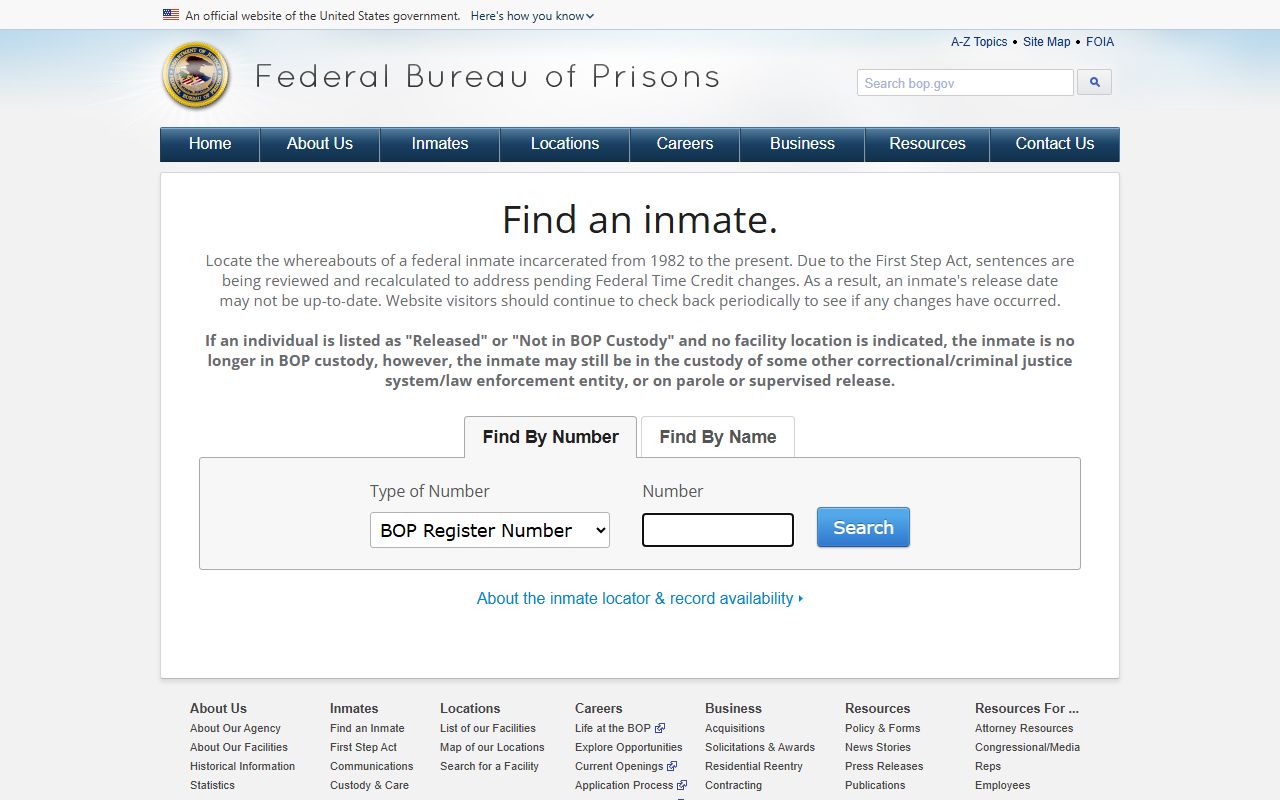
The BOP page warns that release dates may shift due to sentence recalculations and good-time credits. Always confirm a date with the holding facility before driving to pick someone up.
| Field Label | Type | Required | Notes |
|---|---|---|---|
| Find by Number | Tab | No | Use BOP Register Number, DCDC Number, FBI Number, or INS Number. |
| BOP Register # | Text | If by number | Eight digits, format 12345-678. |
| Last Name | Text | Yes if by name | Required for name search. |
| First Name | Text | No | Optional. |
| Middle Name | Text | No | Optional. |
| Age | Number | No | Helps narrow common names. |
| Race / Sex | Dropdown | No | Optional filter. |
California Sex Offender Registry (Megan's Law)
People who must register as sex offenders show up on the California Megan's Law site at meganslaw.ca.gov. The site is run by the California Department of Justice under Penal Code section 290.46. It is not a general release list; it is a public-safety registry. Registrants are barred from using the search tool.
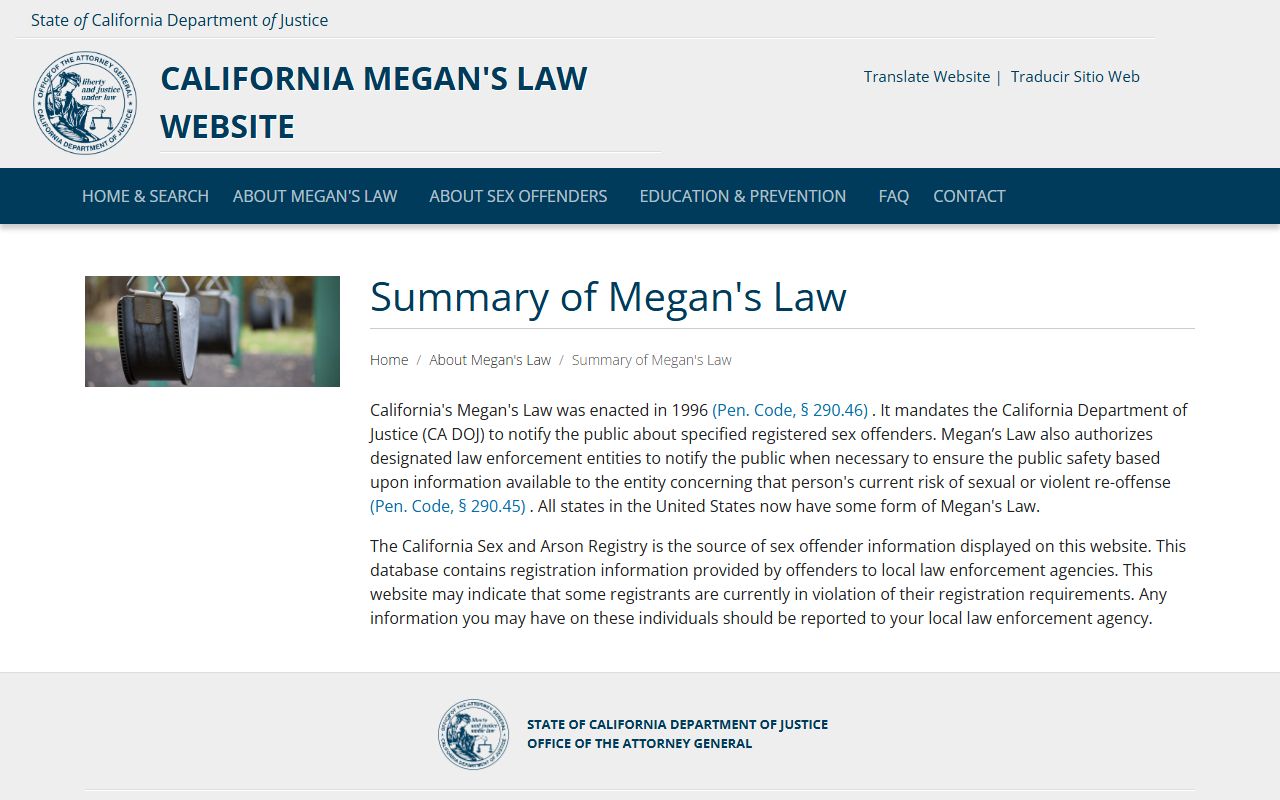
A registry profile lists the registrant's full name and known aliases, year of birth, registered city or ZIP, physical description, photo, and the registerable offenses. Address detail varies by tier and by the registrant's risk class. Some entries show only a city or ZIP; others list a full street address.
| Field Label | Type | Required | Notes |
|---|---|---|---|
| Last Name | Text | For name search | Pick the name-search tab first. |
| First Name | Text | No | Helps cut down result lists. |
| City | Text | For city search | Use the city-search tab. Example: Chula Vista. |
| County | Dropdown | For county search | Pick San Diego from the list. |
| ZIP Code | Number | For ZIP search | Five-digit ZIP. Returns a list with map view. |
| Address / Radius | Text + miles | For radius search | Maps registrants within a mile radius of an address. |
Note: The Megan's Law site warns that misuse of registry data to harass or harm a registrant is a crime.
Verifying Release by Phone
The Sheriff custody line at (619) 409-5000 takes calls 24 hours a day. Press the menu option for the facility holding your loved one. The clerk can confirm whether a person is still in custody, has been released, or has moved to a new jail or to state prison. Phone confirmation beats the live roster when timing matters.
For state-prison releases, call CDCR Identification at (916) 445-6713 during business hours. For federal releases, call the listed phone for the holding BOP facility shown on the inmate locator. Have the full legal name and any known case or ID number ready.
If a relative is the registered next of kin, the records clerk may share more detail, such as where the inmate was driven on release or whether bus fare was issued. Walk-in records visits are sometimes possible at Central Jail; call first to check the lobby hours, since they shift on holidays.
Parole and Probation
After state prison, most people serve time under CDCR parole supervision. The Division of Adult Parole Operations runs San Diego field offices that handle reporting, drug testing, and home visits. After local jail time, people are often placed on county probation through the San Diego County Probation Department.
CDCR Division of Adult Parole Operations
California Department of Corrections and Rehabilitation
P.O. Box 942883
Sacramento, CA 94283
(916) 445-6713
San Diego Sheriff Reentry Services
East Mesa Reentry Facility
446 Alta Road, Suite 5200
San Diego, CA 92158
(619) 409-5000
Vocational, education, wellness, and job-center programs.
Parole violations send a person back to custody. A new arrest, a missed report, or a failed drug test can each trigger a hold. Holds show up on Who's In Jail as a "PAROLE HOLD" charge with no bail.
Reentry Resources in San Diego County
The Sheriff Reentry Services program is built around East Mesa Reentry Facility, which is named for that mission. Services include vocational training, school programs, wellness work, psycho-social services, Veterans Moving Forward, a Job Center, the PRLA program, and Sheriff's Pretrial Services. South Bay also offers counselor-led recovery, NA and AA meetings with bilingual support, and faith services.
- Sheriff Reentry Services: job training, school, wellness, and re-entry coaching.
- San Diego County Public Defender: legal help with expungement and probation issues.
- Legal Aid Society of San Diego: civil clinics for housing, benefits, and records cleanup.
- San Diego Law Library: free public access to legal research tools.
- County Behavioral Health Access line: mental health and substance use referrals.
Civil Rights Restoration After Release
California restores the right to vote once a person finishes a term in state or federal prison. People in county jail as a probation term or for a misdemeanor sentence may generally vote while held, but should check with the California Secretary of State for the latest rules. Voter registration is free and can be done online.
Firearm rights are harder to restore. Most felony convictions trigger a lifetime ban on owning a firearm under state and federal law. Some narrow paths exist, such as a Penal Code section 1203.4 dismissal followed by a reduction to a misdemeanor and a Governor's pardon. Talk to a criminal defense lawyer before buying or holding a firearm.
Employment rights are protected under California's Fair Chance Act. Most private employers cannot ask about a conviction until after a job offer. Public employers and licensed roles have their own rules. For job listings tied to programs, check with Sheriff Reentry Services.
Driver's License Reinstatement
People released from jail or prison often need to fix a suspended California driver's license. Suspensions tied to DUI, failure to appear, or unpaid fines stay on the record until cleared. The first step is to pull a current driver record from the California DMV, then pay any open court fines through Superior Court.
For DUI suspensions, a DMV Mandatory Actions Unit hearing and proof of an SR-22 insurance filing are usually required. For failure-to-appear holds, the court must lift the hold before the DMV will reinstate the license. See court records to pull case files.