
Active Warrants in San Diego County
Active warrants in San Diego County are issued by judges of the San Diego Superior Court. The District Attorney requests most arrest warrants. The court itself issues most bench warrants when a person fails to appear or fails to comply with an order. Once signed, the warrant is logged into the Sheriff's records system and made available to peace officers across the state through the California Law Enforcement Telecommunications System. The Sheriff also posts a public version online so that a person or a family member can check for outstanding matters.
The Sheriff's public warrant database is updated hourly, seven days per week. The page warns that data may be up to 24 hours old in some cases and that recent changes may not show right away. The Sheriff also runs weekly maintenance Wednesday at noon, normally back online within 30 minutes. The system lists only adult criminal defendant warrants out of San Diego Superior Court. It does not cover juvenile, sealed, federal, or out-of-state warrants. Sheriff Kelly Martinez oversees both warrant service and the Detention Services Bureau that books people after arrest.
Types of Warrants in San Diego County
California courts issue several kinds of warrants. Each one targets a different problem. Some come from a fresh criminal filing. Some come from a missed court date. Some come from a judge who wants to search a place or to seize property. The five common types in San Diego look like this.
- Arrest warrant - Issued when there is probable cause that a person has committed a crime. DA-requested, judge-signed.
- Bench warrant - Issued by the court when a person fails to appear, fails to obey a court order, or fails to pay a fine.
- Search warrant - Authorizes a peace officer to search a place, vehicle, or device for evidence.
- Capias warrant - A body attachment used to bring a witness or party before the court.
- Civil warrant - Issued in civil contempt cases or for failure to comply with a civil judge's order.
Bench warrants are the most common kind seen on the Sheriff's public list. They flow out of missed traffic court, missed criminal hearings, and missed family law dates. The fix is often simpler than people expect. Many bench warrants for low-level matters can be cleared by appearing in court and asking the judge to recall the warrant.
How to Search San Diego County Warrants
The main public tool is the Sheriff Warrant Query at apps.sdsheriff.net/WARRANT/waar.aspx. It is a name search. The Sheriff also explains the limits and proper use at sdsheriff.gov/i-want-to/request/warrant-information. Both pages stress that only peace officers may act on a warrant. The public is told to call the Sheriff Warrant Tip-Line at (858) 974-2327, email csbwarrants@sdsheriff.org, or use the online tip form to report a sighting.
- Open the Sheriff Warrant Query page. Read the warning text at the top.
- Type a last name. Partial names work and return more possible matches. Add a first name and middle name to narrow the result list.
- Complete any Cloudflare or Turnstile human check the site shows.
- Click LookUp. If the button is disabled, close and reopen the browser, then try a hard refresh.
- Review each result. The Sheriff warns the database does not store charge text in plain English; use California Legislative Information to look up Penal Code section numbers if needed.
- Call the Sheriff Warrant Tip-Line at (858) 974-2327 to confirm a hit before acting.
Confirm any match by phone before doing anything else. The Sheriff makes clear that the public should not try to arrest a person listed as having a warrant. Only sworn peace officers can do that. The system shows the result set, but the legal authority to act lives with the deputies.
San Diego County Warrant Search Fields
The Sheriff Warrant Query form is short. It does not ask for date of birth. It does not ask for case number. The fields are listed below.
| Field Label | Type | Required | Notes |
|---|---|---|---|
| Last Name | Text | Effective yes | Partial names OK; returns most possible matches. |
| First Name | Text | No | Partial names OK; helps narrow result list. |
| Middle Name | Text | No | Partial names OK. |
| Cloudflare / Turnstile | Challenge | Yes if shown | Human verification step before the system runs the query. |
| LookUp | Button | Yes | May be disabled; refresh or restart the browser if needed. |
Note: Common names will produce many false positives. Use middle name and any known alias to cut down the list before drawing any conclusion.
What a San Diego County Warrant Record Shows
A warrant record is a short document. It tells a peace officer who to arrest, why, and on what bail. The Sheriff display includes the core fields, but the live court file has more detail. The most common fields in a San Diego warrant record are listed below.
| Field | What It Shows |
|---|---|
| Subject Name | Last, first, and middle name of the wanted person. |
| Warrant Number | Court-assigned ID used to track the warrant. |
| Issue Date | Date the judge signed the warrant. |
| Issuing Court | Central, North County, East County, South County, or Kearny Mesa division. |
| Case Number | Tied criminal, traffic, or family case file. |
| Charge / Code | Penal Code, Vehicle Code, or Health and Safety Code section. |
| Warrant Type | Arrest, bench, capias, or other. |
| Bail Amount | Cash or bond required for release; sometimes No Bail. |
| Status | Active, recalled, served, or quashed. |
The Sheriff says charge text in the public file is shown by code section, not in plain English. To read the meaning of a code like PC 273.5 or VC 23152, look it up on California Legislative Information. The court file has the full text.
How to Resolve a San Diego County Warrant
An outstanding warrant does not go away on its own. It stays in the system until the court recalls it. The right path depends on the warrant type, the underlying charge, and bail status. The steps below come from the Sheriff Warrant and Bail page and from common San Diego court practice.
- Confirm the warrant on the Sheriff Warrant Query. Note the case number, issuing court, charge code, and bail.
- Do not treat the database as final. Data can lag by up to 24 hours, so a hit may already be resolved, or a fresh warrant may not show yet.
- Read the Sheriff Warrant and Bail page for courthouse appearance instructions.
- If the warrant has been handled but still shows, contact the court of issue. The Sheriff says it does not hold the court file and cannot recall a warrant on paperwork alone.
- Contact a private attorney or the Public Defender if there is any criminal exposure. Central Public Defender (619) 338-4700; North County (760) 945-4000.
- Appear as directed. Be ready for bail, custody, or a fresh hearing date depending on the warrant type and the judge.
Important: Talk to a lawyer before turning yourself in on a felony warrant. A short call can affect bail, charging, and the path to release.
Bench Warrants and Failure to Appear
Bench warrants make up most of the public list. They are issued when a person fails to appear in court, fails to follow a court order, or fails to pay a fine. The judge signs the warrant at the bench, hence the name. A bench warrant for a missed traffic infraction is treated very differently from a bench warrant for a missed felony hearing. The first may be cleared by a quick appearance, often without custody. The second is far more serious and can lead to a remand into Sheriff custody pending a new hearing.
San Diego Superior Court handles traffic and minor offense matters at the Kearny Mesa Traffic Court at 8950 Clairemont Mesa Boulevard. Most traffic-related bench warrants come from there. Criminal bench warrants come from Central, North, East, or South division courthouses. For traffic details and citation lookups, see traffic court records.
The District Attorney's Role
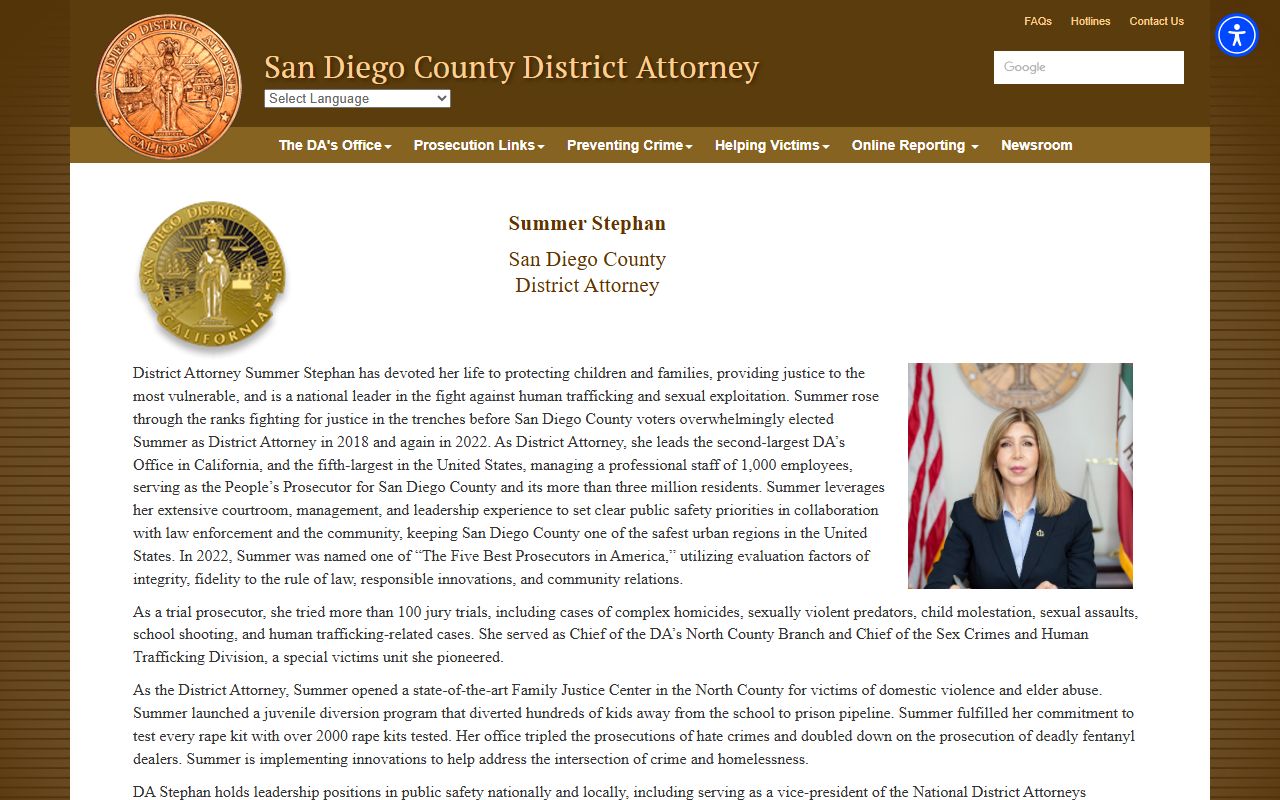
The District Attorney's Office is the prosecuting agency for the county. District Attorney Summer Stephan leads the office, which has about 1,000 staff and serves more than three million residents. The DA prepares criminal complaints, asks the court to issue arrest warrants when probable cause is shown, and prosecutes the charges in Superior Court. The bio page for DA Summer Stephan sits at sdcda.org/office/meet-da.
The official DA bio page covers her election history, prior roles, and policy focus.
The DA central line is (619) 531-4040. Branch offices answer at (760) 806-4004 in North County, (619) 441-4588 in East County, and (619) 691-4695 in South County. Victim Services can be reached at (619) 531-4041. Services for crime victims are free, and there is no citizenship requirement.
Crime Stoppers and Anonymous Tips
San Diego County Crime Stoppers takes anonymous tips on wanted persons and active warrants. Calls go to (888) 580-8477. The tip line pays cash rewards of up to $1,000 for information that leads to an arrest. Tipsters do not have to give a name. The Sheriff also runs its own warrant tip channels. Email csbwarrants@sdsheriff.org. Mail tips to San Diego County Sheriff, Attention Warrant Tips, PO Box 939062, San Diego, CA 92193-9062. The Sheriff Warrant Tip-Line answers at (858) 974-2327.
The Sheriff's office is clear about one rule. Do not try to arrest a person on a warrant yourself. That power belongs to peace officers. A bad-faith private arrest can lead to civil or criminal liability for the person making the attempt.
Sealed and Restricted Warrants
Not every warrant shows up in the public list. Sealed warrants are kept off the public system by court order. Juvenile warrants under Welfare and Institutions Code section 827 are confidential. Federal warrants out of the U.S. District Court for the Southern District of California are not on the Sheriff site. Out-of-state warrants are not on the list either, although they may still be served in San Diego if the issuing state has flagged the person for extradition.
Investigative search warrants are a special case. They are issued in secret to let officers act before the target knows. They are unsealed only after the search is done, or after a judge says it is time. None of these appear on the Sheriff's public warrant query.
Out-of-State and Federal Warrants
The Sheriff's public list only shows San Diego Superior Court adult criminal warrants. A person with a warrant from another county or another state may not show up there at all. Out-of-state warrants are tracked through the National Crime Information Center, run by the FBI. Peace officers can see those during a stop or booking. Federal warrants are run through the U.S. Marshals Service and the issuing federal court.
If a warrant comes from a different California county, the right path is to call the Sheriff or court clerk in that county. If it comes from another state, a local lawyer can advise on extradition risk. The booking process at San Diego County inmate records is the same regardless of where the warrant came from, but the legal path to clear it goes through the issuing court.